Schneider Electric, Microsoft Expand AI Automation for Green Hydrogen Project
Schneider Electric and Microsoft have expanded their collaboration to deploy AI-powered, software-defined automation for industrial applications, including green hydrogen production.
The companies said the collaboration integrates Schneider Electric’s open automation platform with Microsoft Azure cloud, AI and edge infrastructure to support industrial digitalization. The approach is intended to help companies modernize operations without replacing existing systems while enabling greater flexibility and scalability.
The system automates engineering tasks such as writing control logic, configuring systems and navigating documentation, to reduce production changes from weeks to hours. Schneider Electric’s open automation platform separates software from hardware, allowing applications to run across multiple systems and vendors.
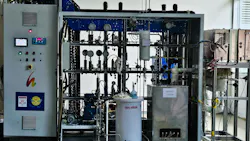
The collaboration was demonstrated through a deployment in India with green hydrogen producer h2e Power, where the companies implemented what they described as the country’s first fully autonomous solid oxide electrolyzer system. The project was deployed on a 20 kW system designed to produce green hydrogen, a process in which electricity accounts for more than 70% of total production cost, the companies said.
The AI-based control system continuously monitors and adjusts operations in real time, including thermal balance, hydrogen flow, energy inputs and equipment health. It has operated for more than 6,000 hours under both partial and full-load conditions, while enabling predictive maintenance and remote operation, according to the announcement.
The system improved energy efficiency, reduced equipment wear and lowered the levelized cost of hydrogen by up to 10%, equivalent to about €500,000 ($588,000) per year for a typical 10 MW plant, according to the companies.