Green Chemistry Process Produces Recyclable Fire-Resistant Composites
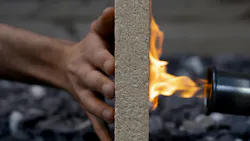
A green chemistry process using enzyme-controlled mineral crystallization to produce high-performance, flame-retardant composites from sawdust and struvite has been demonstrated by researchers at ETH Zurich and Empa — with potential implications for mineral processing, crystallization reactor design and industrial waste stream recovery.
The study, published in Chem Circularity, centers on an enzymatically induced solid-mineral phase transformation from newberyite to struvite under confinement. Urease extracted from watermelon seeds catalyzes urea hydrolysis, providing controlled, gradual release of ammonium ions that drive crystallization.
According to the research paper, this controlled ion release was critical to producing large, well-defined struvite crystals capable of conforming to complex particle surface topography — a result difficult to achieve through conventional crystallization methods. The approach demonstrates how enzymatic reaction rates can serve as a process lever for controlling crystal morphology and mineral phase outcomes in composite manufacturing.
For plant operators managing wastewater effluent, the process also points to a feedstock opportunity. Struvite accumulates as a pipe-clogging precipitate in wastewater treatment systems and is typically treated as a disposal problem. According to the press statement, the researchers identified these deposits as a viable raw material source for the binder, reframing an operational nuisance as a recoverable process input.
The composite itself demonstrated full recyclability through straightforward thermal and mechanical processing — mineral precursor recovery, re-precipitation and reuse without significant loss of mechanical performance — consistent with circular economy process design principles.
Next steps include scaling production and optimizing the crystallization process for larger reactor systems. According to the press statement, binder cost relative to conventional alternatives remains the primary barrier to industrial adoption, though waste stream sourcing could improve the economics.