Physics Plus AI: A New Era for Pipeline Leak Detection




How AI is reshaping pipeline leak detection? Chemical Processing Editor-in-Chief Traci Purdum talks with KROHNE's Maximilian Ihring and Daniel Vogt to answer that question. The following conversation, edited for clarity, examines how conventional systems rely on static hydraulic models that lose accuracy as conditions change. KROHNE's PipePatrol NEO layers supervised machine learning on proven physics-based models, improving sensitivity and reducing costly false alarms while keeping physical laws as guardrails. Also discussed: challenges unique to chemical pipelines, field results showing major performance gains and the importance of data quality. The bottom line — human operators must keep authority over critical decisions as AI evolves.
Transcript
Traci: What has changed in computing power, data availability or operator expectations that makes an adaptive, AI-assisted approach practical now rather than 10 years ago?
Daniel: First, operators' expectations have changed a lot. They no longer expect just an alarm or no alarm from the system. They expect earlier warnings, higher sensitivity, more accurate leak localization and higher reliability, with fewer false alarms.
Two other big changes are data and computing power. Data availability is much better than it was five or 10 years ago. We now have years of historical operational data and alarm histories. As a company, KROHNE has more than 40 years of experience in leak detection and a wealth of operational data we can leverage for training.
We also now have much more CPU and GPU capacity at an affordable cost. Today's computing power allows real-time processing of high-frequency pressure, flow and temperature data. That means AI can finally learn what normal looks like in a pipeline over time, which allows us to meet customers' increased expectations.
Maximilian: Unlike conventional systems, which lose performance over time, PipePatrol NEO's Neural Engine Pipeline Monitoring is designed to use data that is generated continuously. Regular performance reviews and KPI-driven analysis support long-term stability, fewer nuisance alarms and consistent, explainable results throughout the pipeline life cycle.
The practical implication is a monitoring system whose detection capability doesn't simply hold steady after commissioning but is actively maintained — and in many cases improved as more data becomes available. That's a meaningful departure from the traditional life cycle of a leak detection system, which typically peaks shortly after commissioning and then slowly declines. Instead, you have a continuously improving system.
Monitoring System Challenges
Traci: Let's talk about the unique challenges that specialty chemicals, liquefied gases and supercritical fluids present for monitoring systems.
Daniel: There are many challenges, specifically in the chemical industry and in pipelines transporting chemical gases. To mention a few: In chemical pipelines, we see strongly nonlinear fluid behavior, meaning density and compressibility can change significantly along the pipeline. Pressure and temperature changes have a large impact on the calculated imbalance for the pipeline.
We also see many kinds of products. With liquefied gases, we can have phase flashing, vaporization and two-phase behavior — think of carbon dioxide or dense-phase ethylene. We also have very fast transient dynamic effects. Pipelines are often used as a buffer tank between two chemical plants, and their upstream and downstream conditions may look dramatically different.
With supercritical fluids and specialty chemicals, we sometimes have limited or incomplete data on their pressure-volume-temperature relationships, which results in unusual viscosity or compressibility characteristics. Compositions change, too.
So, what we see in the chemical industry differs in many ways from traditional, simple liquid pipelines. From a leak-detection perspective, operational transients create patterns that resemble leaks, making the static thresholds of older systems less effective. This is where AI helps us build better, more reliable systems. It recognizes recurring process signatures and helps distinguish normal behavior from abnormal behavior.
Failure Modes
Traci: Leak detection has two failure modes — false alarms and missed leaks — and both can cost facilities a lot: shutdowns, lost throughput and controller fatigue on one side, and product loss, cleanup, fines and reputational damage on the other. Can we talk about that?
Maximilian: Absolutely, Traci. Thank you for bringing up not only missed leaks due to non-functioning leak detection but also false alarms. A false alarm isn't just a software nuisance. It has a serious impact. Many operators know that too many false alarms erode their trust in the system.
It's like a car alarm. If it always goes off and no one is stealing the car, I might check the first five times. The sixth time, when someone really is trying to steal my car, I'm not checking anymore. That's a big issue.
Also, requirements such as those in API 1175 say operators must treat every alarm seriously. They have to follow the response procedure, do root-cause analysis, keep records and conduct investigations. We estimate each alarm costs about $1,000, maybe more. If you assume one false alarm a day, that easily adds up to $365,000 a year.
If pattern recognition and artificial intelligence methods can help reduce these false alarms, we think that should be done. That was a big reason we went in this direction: to truly distinguish between real alarms and false alarms while, of course, not missing leak events. We're all aware of accidents around the world, and some of them easily cost millions. State-of-the-art leak detection can help you detect leaks before they become serious and keep costs to a minimum.
AI Complements Rather Than Replaces
Traci: How does AI complement traditional hydraulic modeling rather than replacing it?
Daniel: With PipePatrol NEO, we don't replace physical models with artificial intelligence. We've used physical relationships — conservation of mass, momentum and energy — in our systems for many years. Those relationships have been well known for decades and proven accurate. Why would we throw that knowledge away? Physics still provides the explainability; AI adds the adaptability. We don't want AI to rediscover physics, and this dramatically reduces the complexity of the problem.
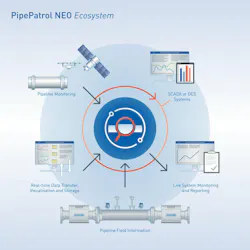
So instead of a pure black-box approach using AI alone, we rely on E-RTTM, our extended real-time transient model-based system, as the foundation for leak detection. PipePatrol NEO adds machine learning capabilities around that foundation, so AI can improve sensitivity and distinguish operational patterns.
Physics-based models also offer functionality that AI-only approaches can't, and it remains available in the NEO environment — for example, hydraulic profiles that help identify critical pressures, overpressures and phase changes. That addresses many of the problems we discussed earlier. The physics-based foundation stays central. The hydraulic model still represents pipeline behavior, and the neural engine's job is to keep that model and the classification logic built on it aligned with reality as conditions change.
Traci: Let's go back to something you mentioned about the system learning. If the system continuously adapts to normal operating behavior, what stops it from slowly learning a small, developing leak as the new normal?
Maximilian: That's a very fair question, because we've seen earlier self-learning approaches learn small leaks into normal operating behavior. What's important here is that PipePatrol NEO's Neural Engine Pipeline Monitoring uses supervised learning, not unrestricted online learning.
We use artificial intelligence techniques to optimize the system, but the optimization isn't left unchecked. All AI-assisted adjustments are validated by experts — people with 10 or 20 years of industry experience working with leak detection. AI makes their work easier, but they still evaluate the results. The adjustments are also aligned with recognized standards such as API 1130 and API 1175.
We don't just let the AI run, which you could do if you used AI without physics. That always carries the risk of learning behavior you don't want it to learn. We mitigate that risk by combining AI with a physics-based approach and expert validation. In the end, the system still uses physics-based models that serve as independent guardrails. Conservation of mass, momentum and energy are locked into the system, and the AI cannot simply accept a physical imbalance as normal.
Traci: You both have deep expertise and many years of research on this. Looking back at AI-assisted monitoring, what has surprised you? Where did the technology perform better than expected, and where did it struggle or require more human involvement than planned?
Daniel: What surprised us was how much older systems can benefit. Because AI can exploit historical operational behavior — and we have lots of data available — it can better discriminate operational transients from real leak events or false positives.
The sensitivity improvement is substantial. In several field evaluations, sensitivity improved roughly 270%, and model accuracy improved by almost 30%.
Just last week, we ran the PipePatrol NEO AI algorithms on an existing pipeline for one of our U.S.-based customers. The smallest detectable leak rate had been 1% of throughput, or 18 barrels per hour, within a 15-minute confirmation period. The AI improved that to 10 barrels per hour within a four-minute confirmation period. In terms of leak volume, that's a reduction from 4.5 barrels to 1.25 barrels — an improvement of almost a factor of four just by applying AI optimization to the existing model-based system. Having worked on this topic for 20 years, I'd say that's better than expected.
But data quality matters enormously, and instrumentation is still very important. Bad time stamps, noisy signals or missing data also affect the AI. Some unusual operating conditions are still difficult, and human process knowledge remains very important. AI is not magic. It does not compensate for bad meters, poor instrumentation, missing data, poor process understanding or a bad commissioning job. AI amplifies good data and good engineering, but it does not replace them.
Maximilian: I agree with Daniel, and I was also pleasantly surprised by the results. We expected potential gains from artificial intelligence — we were thinking maybe 20% or 30% — but we couldn't have imagined an improvement of almost a factor of four. Those are outstanding results. And as mentioned, I think this combination of physics-based and AI techniques, and the performance it delivers, is the future.
AI's Future in Pipeline Operations
Traci: Speaking of the future, let's look ahead five to 10 years. How do you expect the role of AI in pipeline operations to evolve beyond leak detection toward predictive maintenance, integrity management or more autonomous response? And where should the human controller always remain in the loop?
Maximilian: On top of the performance improvements we've already seen, there are many other opportunities, including enhancing pipeline monitoring through more accurate models, more automated analysis and more sustainable operational processes.
One is incorporating additional classification parameters — data that traditionally hasn't been used for leak detection or pipeline monitoring but that AI techniques show can improve monitoring results. AI also might take over classification tasks directly, which could reduce manual effort and increase both the consistency and scalability of pipeline leak detection systems.
Looking further ahead, AI has the potential to support — and in some respects extend — the traditional digital twin approaches we already see in the industry, using neural network models capable of learning complex system behavior from large operational data sets.
There's also transfer learning. Learning done on one pipeline application, perhaps over years or decades, can be transferred to new applications. That way, new pipelines, pipeline sections or product types can reach full detection performance within a very short time.
Daniel: I actually expect AI to move from being primarily a leak detection technology to becoming an operational intelligence layer.
Today, the main value is detecting anomalies and helping operators interpret them. But through the leak detection system, we already access all the data coming from the field, the instruments and SCADA. Over time, that same infrastructure can support predictive maintenance, integrity management and operational optimization, such as pump optimization or early identification of conditions that increase leak or failure risk.
Importantly, I don't expect the human operator to disappear. In a safety-critical environment, I think the right model is increasingly autonomous analysis but human authorization for consequential actions. We should draw a clear line here. AI can increasingly monitor, detect, correlate, diagnose, predict and recommend. But humans — people like you and me — should remain responsible for major operational decisions: emergency response, shutdowns, actions with safety or environmental consequences, and situations outside the model's validated operating envelope.
For more information, visit: https://www.krohne.com/en-us/solutions/monitoring-solutions/pipepatrol-neo