Roundup: Chemical Industry Products to Watch - April 2026

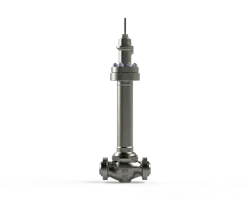
Cryogenic Control Valve Reduces Leakage and Energy Loss
Emerson introduced the Fisher IC2 cryogenic top-entry control valve, designed for low-temperature applications such as cold boxes in air separation units, hydrogen liquefaction and LNG production. The valve operates at temperatures as low as -452°F (-269°C) to support performance in cryogenic environments.
The control valve incorporates a narrow extension diameter and fluid baffle to reduce heat conduction, lowering the energy required to maintain process fluid temperatures, according to the company. An enhanced packing system and bellows reportedly limit leakage to a maximum of 100 parts per million by volume, meeting or exceeding U.S. Environmental Protection Agency standards.
Designed for durability, the valve features hardened trim materials, metal-to-metal seating and an enhanced packing system to extend service life. Maintenance is supported through a top-entry design, modular stem assembly and replaceable internal components, including the bellows, valve plug and seat ring.
The valve is rated for CL600 pressure class and is available in sizes from 1 to 4 in., with additional options planned.
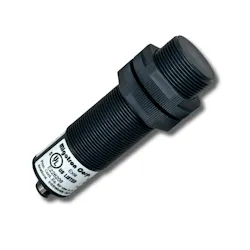
Intrinsically Safe Ultrasonic Sensor Enables Hazardous Area Measurement
Migatron introduced the RPS-429AA-80P-IS2 intrinsically safe ultrasonic sensor, designed for distance measurement and object detection in hazardous and explosive environments.
The ultrasonic sensor is certified for use in hazardous locations, including ATEX, IECEx and C-UL-US approvals, enabling operation in Zone 0, 1, 2, 20, 21 and 22 environments as well as Class I, II and III locations, according to the company. It is designed to deliver accurate distance and level measurements in demanding conditions.
Housed in an IP66/IP67-rated enclosure, the sensor is protected against dust, moisture and washdown exposure. The design includes no moving parts to support continuous operation with minimal maintenance, which reportedly reduces downtime and service requirements.
The sensor features a 4-20 mA two-wire current loop interface for integration into industrial systems.

DCS Enhances Connectivity and Modernization
ABB introduced the SPR2025 release of its Symphony Plus distributed control system (DCS), designed to support system modernization and improve operational performance through enhanced connectivity and upgrade capabilities.
The release enables online upgrades, version synchronization and automated conversion tools to support system updates with minimal disruption, according to the company. It also adds system-wide OPC UA connectivity, an ethernet backbone and support for field device integration using Field Device Integration technology to enable standardized and interoperable communications.
The distributed control system includes Automation Extended functionality, which separates control and digital environments to allow deployment of monitoring, analytics and AI-based applications while maintaining core system reliability and security.
Additional updates include support for the latest Microsoft operating systems and virtualization platforms to simplify lifecycle management, along with expanded connectivity through virtual plant network interfaces to improve communications and reduce system footprint.
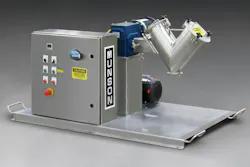
Cantilevered Vee Cone Blender Supports Uniform Mixing
A cantilevered Vee Cone blender with intensifier bar from Munson Machinery Company is designed to optimize mixing parameters for bulk solid materials, with or without liquid additions, in laboratory and small-batch applications.
The blender features interchangeable vessels in six sizes ranging from 0.25 to 16 qt. Two inclined cylinders rotate end over end to move materials through repeated convergence and division, achieving uniform blends in typically 5 to 15 minutes with reportedly less product degradation than agitated systems.
An intensifier bar reduces soft agglomerates and improves material diffusion, while an optional dispersion bar enables liquid additions to be sprayed onto moving material for more even distribution, according to the company. Smooth internal surfaces support unobstructed flow and complete discharge through a gate valve.
The unit is designed for cleaning and inspection, with minimal residual material and access through the discharge valve and cylinder doors. A control panel allows variable adjustment of programmable functions, and the blender is constructed of 316 stainless steel with finishes available for sanitary or industrial requirements.
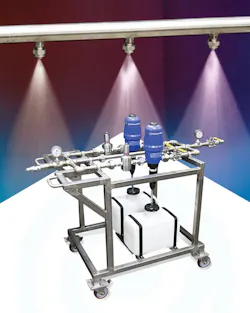
Modular Spray System Enables Mobile Equipment Cleaning
BETE introduced the FlexiSan modular spray system, a portable solution designed to support equipment cleaning and sanitization with a mobile, integrated spray setup.
The system features a mobile cart with a clean-in-place spray header that connects directly to a facility water line. Two blending pumps allow the unit to hold up to two liquids simultaneously, enabling operators to switch between rinsing, cleaning and sanitizing functions, according to the company.
Designed to handle both light washdowns and heavier buildup, the spray system is available in a higher-capacity configuration for more demanding cleaning requirements. Precision spray technology is designed to minimize liquid waste while maintaining effective coverage.
The modular system is intended to support flexible deployment across processing areas, allowing operators to move the unit where needed.