Toxic Chemical Investigation Expands on Cayuga Island in Niagara Falls
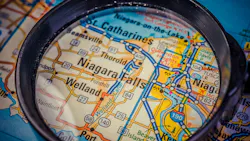
The state has expanded its investigation of Cayuga Island in Niagara Falls, searching for more evidence of toxic chemicals linked to industrial fill used beneath homes there.
Many homes on Cayuga Island were built on fill from Niagara Falls’ chemical industry beginning in the early 1900s and continuing through the 1960s.
In October, tests by the state Department of Environmental Conservation showed high amounts of toxic pesticides, alpha-BHC and beta-BHC, as well as mercury in the soil along West Rivershore Drive after workers replacing a waterline smelled chemicals as they dug in the road.
By June, the agency had contacted 22 property owners on the western end of the island to ask if staff could test their soil, indoor air and basement sump pumps for the chemicals to determine whether residents’ health was at risk.
Only seven have granted the agency access so far.
The 140-acre, largely residential Cayuga Island is in the LaSalle section of Niagara Falls. The Niagara River runs along its southern shore, while Little River separates the island from the mainland to the north.
On Sept. 8, the DEC reached out to an additional 12 property owners on the island to request access for further investigation. The 12 are just east of the island’s westernmost 22 properties.
“We were able to more thoroughly use some techniques in order to evaluate historical aerial photos, which we believe showed that filling may have occurred further east,” said DEC Region 9 Interim Director Chad Staniszewski.
Staniszewski added that the DEC found soil contamination at the easternmost boundaries of its original investigation. So the agency wanted to keep working east along West Rivershore Drive to ensure it found the full extent of the pollution.
“We decided, based upon those aerial photos and the fact that we have not hit clean (soil) yet, as far east as we were able to sample, to reach out to an additional 12 properties,” Staniszewski said.
Of the 12 properties the DEC reached out to earlier this month, four have given the agency access for further investigation.
Toxic chemicals found under soil in Niagara Falls neighborhood spark state investigation
The state has found toxic industrial waste under the soil on Cayuga Island in Niagara Falls. It's working with homeowners to determine whether peoples' health are at risk.
Natalie Gigliotti is one of them. She had also called the DEC after hearing in June that the western tip of the island was being investigated for toxic chemicals in the soil.
Gigliotti, who has lived on the island for eight years, said she’s concerned that she, her husband and their two 6-year-old sons could be exposed to toxins in the soil, their garden or the air inside their home.
“I’m definitely concerned,” she said, “and I personally don’t want to leave it for future decades to deal with.”
Another nearby resident, Lauren George, said she doesn’t want the DEC to do testing. She has lived on the island for 52 years and figures that if she had been exposed, she would have felt the effects by now.
Of the seven property owners who had granted the DEC access to investigate their soil, indoor air and sump pumps during its original investigation, only one had unhealthy concentrations of chemicals found in the indoor air.
Cleanup advances at Niagara County site tied to Manhattan Project
The U.S. Army Corps of Engineers has nearly finished phase one of its cleanup of the Niagara Falls Storage Site off Pletcher Road in Youngstown.
The DEC then installed a system to ensure the indoor air was regularly vented and circulated so toxins would not build up, Staniszewski said.
But all of the properties had unsafe levels of mercury and the pesticide chemicals found in their soil, Staniszewski said, so, “all seven of those properties will have the top 2 feet of soil removed and replaced.”
That work is expected to happen next year, he said.
The agency is only removing the top 2 feet of soil even though the toxic soil likely extends much deeper underground, he noted.
“To remove all the fill, we would have to remove all of the houses, and that isn't practical in this situation,” Staniszewski said. “I don't believe the homeowners would want us to do that. So, it's feasible to remove the top 2 feet without significantly impacting the infrastructure that's there.”
Once the agency removes the top 2 feet of soil, it will place a “demarcation layer,” or a plastic orange mesh, to clearly show where contaminated soil begins. On top of that, the agency will place 2 feet of clean soil, Staniszewski said.
If property owners want to do work in the future that could impact the soil further than 2 feet down, they will need to inform the DEC, he added.
Staniszewski said the DEC also tested the sediments at the bottom of the Niagara River around the island to check whether any of the pollution had moved. The agency didn’t find any of the same chemicals, however.
As for the four properties that had granted the DEC access in its latest investigation, Staniszewski said agency representatives will conduct indoor air, sump pump and soil testing within the next two weeks.
The other 23 property owners in both investigations haven’t allowed the DEC on their property, meaning the agency has no way to determine whether residents’ health is at risk.
In the October tests, each chemical level far exceeded the DEC’s residential soil cleanup objective amounts, or the amount considered safe in the soil.
Up to 28 parts per million of alpha-BHC were found in the soil along West Rivershore Drive, about 667 times the DEC’s safe limit of 0.042 ppm. The average amount of alpha-BHC in the soil was about 1.75 ppm while the median was 0.13 ppm, according to data from the DEC shared with The Buffalo News.
Beta-BHC was found in the soil at levels up to 210 ppm, or 5,000 times above the DEC’s safe limit of 0.042 ppm. However, the average was just 12.3 ppm and the median 0.52 ppm, according to the DEC’s data.
Mercury was found at consistently higher amounts than the other two chemicals, with a maximum of 1,120 ppm − 3,733 times above the DEC’s safe limit of 0.3 ppm. According to the DEC's data, the average mercury level in the soil was 92.8 ppm, and the median was 6.6 ppm.
As Niagara residents seek Superfund status, a Lockport site shows the long cleanup road ahead
Residents near Eighteenmile Creek in Lockport first asked officials to test the soil in their backyards in 2002. But fast forward decades and cleanup efforts are still far from finished.
Alpha-BHC and beta-BHC are most toxic when ingested, but can also be harmful if inhaled. Both are suspected to cause cancer, according to the U.S. Agency for Toxic Substances and Disease Registry and the U.S. Environmental Protection Agency.
Mercury is a known neurotoxin and, if consumed or inhaled, can cause a host of health impacts such as skin rashes, mood swings, memory loss, muscle weakness, tremors, insomnia, headaches, loss of peripheral vision, lack of coordination and impairment of speech, hearing or walking, according to the EPA.
If the DEC identifies a company as having placed the contaminated fill material on the island, it could require the company to pay for any cleanup work, Staniszewski said.
“Our attorneys are still looking into and trying to seek information from who we consider potential responsible parties,” he said. “That work is ongoing.”
© 2026 The Buffalo News (Buffalo, N.Y.). Visit www.buffalonews.com. Distributed by Tribune Content Agency, LLC.