5 Quick Questions: Anoosheh Oskouian Is Breathing Easier

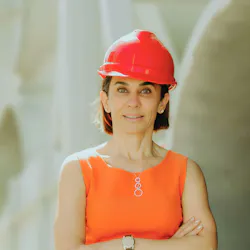
Anoosheh Oskouian is the president and CEO of Ship & Shore Environmental, Inc., holding a bachelor's degree in chemical engineering from the University of Colorado Denver. She began her career as a process engineer at Fluor before transitioning into environmental solutions. She leads a team that designs and delivers custom-engineered industrial air pollution abatement systems. She has served on multiple industry boards, including the South Coast Air Quality Management District's Best Available Control Technology committee, and acts as an environmental consultant for the Society of the Plastics Industry. She also founded Green Energy Industrial Solutions and is a founding member of CHILD (Children’s Hope International Literacy & Development).
When she appeared on my radar, I knew I wanted to ask her my favorite five questions.
What's something you've learned recently that changed how you approach your work?
Honestly, I used to view environmental regulations as a hurdle we helped companies clear—a necessary checkbox. But lately, I’ve realized the ground is shifting way too fast for that. It keeps me up at night, to be completely transparent. We're seeing tighter rules pop up constantly around things like microplastics and PFAS, and it's not just about staying compliant anymore; it's about a company's survival.
It completely changed my approach. I’m spending a lot less time talking about meeting today’s standards, and a lot more time having hard, honest conversations with clients about what’s coming next. We have to build systems that can actually adapt and grow with the changing rules, rather than just slapping a temporary band-aid on the problem.
What part of your work energizes you most, and what drains you?
The ultimate high for me is walking onto a site and seeing this massive, highly technical piece of equipment — something we sketched out on a whiteboard — actually pulling harmful stuff out of the air. Knowing a neighborhood is breathing easier because of a system we built? That’s the best feeling in the world.
But what really drains me — and it breaks my heart a little — is when companies hesitate. It's usually not because they don't care, but because they still look at doing the right thing as just another line-item expense instead of a way to protect their future. By the time they finally pick up the phone to call us, the situation is usually much worse, and it ends up costing them — and the environment — so much more than if we’d just tackled it early.
If you could solve one problem in the chemical industry tomorrow, what would it be?
I would magically bridge the gap between having a brilliant idea and actually putting it to use. It’s incredibly frustrating because we already have the technology to drastically cut emissions and clean up these facilities. The tools are sitting right there! But getting everyone to adopt them is so agonizingly slow and fragmented.
If I could wave a wand tomorrow, I’d get the regulators, the plant managers and the financial folks all sitting at the same table, speaking the same language. If we could just align our goals, we could move so much faster. You really can be profitable and clean at the same time — we just have to stop dragging our feet.
What's a project or accomplishment you're proud of that others might not fully appreciate?
This might sound funny, but I’m most proud of the things you can't see. We design these massive systems that just quietly hum along in the background at a factory, capturing nasty pollutants. Nobody writes splashy headlines about them, but the sheer amount of engineering and long-term planning it takes to make them work flawlessly is intense.
It’s a quiet kind of victory. For me, the real proof hits me whenever I fly into LAX. If you compare the sky over Los Angeles now to what it looked like 25 years ago… it’s night and day. Knowing that the invisible, behind-the-scenes work we do every day is part of the reason that sky is clearer? That means everything to me.
How has your work influenced how you see the world outside of your job?
I literally can't take a deep breath outside without thinking about the hidden systems that make it possible. I think I used to take clean air for granted, like most people. Now, I see that a clear sky isn't an accident — it’s a deliberate choice. Someone had to invest in it, someone had to care and someone had to be held accountable.
Surprisingly, doing this heavy work has actually made me a lot more optimistic. You read the news and it’s easy to panic, but I get to see the actual solutions being built and installed every single day. The fact that we’ve managed to put a real stop to some of the most aggressive climate changes shows we are stepping in the right direction. We still have a long way to go, but knowing the fixes are real and out there keeps me going.
About the Author
 Traci Purdum
Traci Purdum
Editor-in-Chief
Traci Purdum, an award-winning business journalist with extensive experience covering manufacturing and management issues, is a graduate of the Kent State University School of Journalism and Mass Communication, Kent, Ohio, and an alumnus of the Wharton Seminar for Business Journalists, Wharton School of Business, University of Pennsylvania, Philadelphia.
Recent Awards:
2025 Eddie Award for her column "Lax Regulations Burn Rivers"
2024 Jesse H. Neal Award for best podcast Process Safety with Trish & Traci