Electrification Reshapes Chemical Industry's Carbon-Cutting Future
Key Highlights
- Sypox's electric steam methane reformer uses 10MW of renewable electricity and occupies just 20% of a conventional reformer's footprint.
- Coolbrook successfully cracked 100% plastic-waste-derived pyrolysis oil at pilot scale, advancing toward commercial demonstration with petrochemical partners.
- Air Liquide's $29.2 million ASU electrification in China will cut CO2 emissions by 224,000 t/yr, rising to 550,000 t/yr with low-carbon energy.

The decarbonization potential of using renewable electricity to drive energy-hungry processes is prompting continued progress, with steam methane reformers, steam crackers and air separation units all making headlines.
World's Largest Electric Steam Methane Reformer Takes Shape
In September, Clariant announced a supply agreement to manufacture and deliver catalysts for what is planned to be the world’s largest electric steam methane reformer (eSMR).
Under development since 2021 by the Technical University of Munich spinout Sypox, the eSMR is scheduled to begin operations in 2026, utilizing 10MW of renewable electricity to generate approximately 150 t/day of syngas.
While traditional fired SMR processes rely on fossil fuel combustion outside reactor tubes, Sypox reformers directly electrify the chemical conversion inside the reactor.
In a webinar to coincide with the announcement, Sypox Chief Technology Officer Martin Baumgartl said, “Since 2021, we have been scaling up our electrically heated reactor concept. What makes this special is that we are using resistive heating elements, which are in direct contact with our reactive gases and allow us to heat them up very efficiently and convert them into product.”
Baumgartl emphasized how much simpler the eSMR process concept is compared to its conventional counterpart. For example, the convective process section and associated heat integration steps that fired reformers rely on to compensate for the loss of energy from an external heating process are no longer present.
“So not only decarbonizing a lot by using renewable electricity, but also simplifying your process stream,” Baumgartl noted.
Compact Design Reduces Footprint and Costs
The technology itself consists of a pressure vessel containing reactive gases, which are kept at a pressure of 20-40 bar. The vessel has an internal refractory lining to prevent heat loss to the outside.
The innermost part of the pressure vessel contains a catalytic section, which is heated externally by renewable electricity. This section is composed of hollow pipes, each containing a resistive heat element passing through its center. While this configuration alone is a very good method of heating, each wall within the pipes is also coated with a ceramic catalyst. The reactive gases are passed between the inner heating element and the ceramic-coated pipe wall.
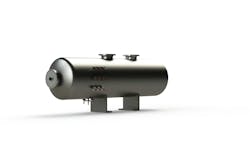
Baumgartl pointed out that the process intensification steps of the eSMR make it much more compact than a fired reformer, as well. A typical fired reformer needs a building approximately 20-25 meters tall, compared with the eSMR, which is 5 meters long and 2 meters in diameter. Not only does this decrease the footprint of the installation, but it also reduces its capital expenditure, he added (Figure 1).
There are two main targets for the technology. One example is the decentralized production of hydrogen, such as from biogas and biorenewable feedstocks that are available in limited quantities. The other is in a centralized production situation, such as a refinery or petrochemical plant, where methanol, ammonia and efuels are being produced.
Tailored Catalyst Development Overcomes Key Challenges
However, while reforming catalysts have been on the market for years, and Clariant has over 70 years of experience with them, the Sypox process posed new challenges.
Speaking at the same webinar, Keitaro Shinkawa, senior business development manager with Clariant, said, “One of the key challenges is that conventional reformer catalyst formulations, which typically contain over 5% nickel, are unstable in the Sypox reactor conditions. Another was with the physical stability of the catalyst coats within the reactor tubes. So we had to both optimize catalyst performance for the reactor and develop a tailored procedure to apply the active catalyst mass to the ceramic carrier.”
In the end, the best catalyst was found to contain just 1% nickel. It maintained gas conversion at over 90% even after 1,000 hours of operation in prolonged exposure to high-temperature (1,000°C) steam. In contrast, a conventional catalyst’s performance fell to below 80% in the same environment.
Shinkawa added that the plan now is to progress from 100 kg/day to commercial-scale production, which is slated for 2026.
Coolbrook Cracks Plastic Waste-Derived Oil
In September, Coolbrook announced a major breakthrough in circular plastics and materials, having successfully cracked 100% plastic-waste-derived pyrolysis oil (py-oil) at its large-scale pilot facility using RotoDynamic Reactor (RDR) technology.
The company has combined space science, turbomachinery and chemical engineering in its two technology developments. RDR is being developed to achieve 100% CO2-free olefin production, while the RotoDynamic Heater (RDH) aims to provide carbon-free process heating to a raft of large energy-using industries.
RDR is being developed to electrify steam cracking, and aims to eliminate 100% of the CO2 emissions created by traditional steam cracking, while increasing the yield of high-value chemicals, such as ethylene, propylene and butadiene from the process.
Coolbrook demonstrated RDR with the successful cracking of naphtha at its Brightlands pilot plant in the Netherlands in 2023, expanding it the following year to take additional feedstocks.
In 2025, the company achieved its target of covering recycled and sustainable feedstocks.
Asked whether the company is where it wants to be in terms of technology development, Chief Commercial Officer Lauri Peltola replied, “Yes we are. We have demonstrated the viability of the technology at the pilot and collected performance data to the extent that we can proceed conceptual design of a commercial RotoDynamic Reactor for cracking various feedstock electrically, including plastic-waste derived pyrolysis oils.”
Next up, she anticipates a commercial demonstration reactor that would be operated in connection with a customer’s steam cracker. “We are currently discussing with a multitude of petrochemical companies on such a demonstrator,” she added (Figure 2).
She declined to say whether Borealis is included in these discussions. Borealis, like Coolbrook, is part of the EU Horizon programs €21.5 million ($25.3 million) eLECTRO project, which aims to develop an electrified pathway for converting mixed plastic waste into light olefins.
Borealis is leading the section titled “optimized valorization of hydrocarbon mix”. Its role will be to evaluate methods to valorize py-oil, assess its composition, demonstrate steam cracking of py-oils and develop appropriate operating strategies for steam cracking.
Under the “work performed and main achievements” section of the EU’s funding and tenders portal, it says that estimates of the electrical needs of a commercial RDR “should be similar to the production of one nuclear power plant and that using only renewable energy will be too challenging. Alternative or hybrid solutions should be identified.”
The results and impact section of the same portal notes that in terms of societal impacts, eLECTRO has observed that the circular plastics economy is characterized by a number of cross-cutting issues that are evident in current policy debates and associated academic literature. However, in this complex context, it remains unclear how to integrate which and what type of cross-cutting issues in technology development to generate societal impact.
Project coordinator – the University of Ghent in Belgium – aims to address this complexity by developing a strategy for integrating cross-cutting issues into technology development. However, enquiries about how such a strategy could work in practice went unanswered.
The project began in September 2022 and will run until the end of August 2026.
Air Liquide Invests in ASU Electrification
Meanwhile, in December, Air Liquide revealed a planned €25 million ($29.4 million) investment in its air separation unit (ASU) at an industrial hub in Yulin, Shaanxi Province, China.
The plan is to convert the existing steam-driven ASU to an electricity-driven system, cutting CO2 emissions by 224,000 t/yr – rising to 550,000 t/yr as more low-carbon energy sources come online.
An extension of an existing supply contract with a subsidiary of the Yanchang Group, the revamp will also increase the ASU’s oxygen capacity by 10% when commissioned in 2027.
This latest ASU revamp follows two others announced in 2023. This €60 million ($70.6 million) project covered ASUs operated by Air Liquide in the Tianjin industrial basin, also in China, and followed the renewal of a long-term industrial gas supply contract with a local chemical group, YLC.
The units are capable of producing 4,000 t/day of oxygen and were successfully commissioned in 2024, marking a first for the French company in China's electrification.
As part of the same contract, Air Liquide signed a three-party memorandum of understanding with YLC and the Tianjin Binhai District, specifically to explore the implementation of carbon capture, use, and storage (CCUS) solutions and to investigate the potential supply of low-carbon energy to the units.
Large-Scale Electric Steam Cracker Moves Into Evaluation Phase
Meanwhile, neither BASF nor Linde was able to provide an update on the progress of their demonstration large-scale electrically heated cracking furnace operation at the Ludwigshafen site.
Hailed by its partners as the world's first large-scale electrically heated steam cracking furnace, it commenced regular operations in April 2024, following three years of development, engineering and construction work.
By this stage, the plan was to have completed trials with two separate demonstration furnaces, one using direct heating to cracking coils, the other using indirect heating from heating elements placed around the coils. Additionally, the two electrically heated furnaces, working together, would process around 4 t/hr of hydrocarbon feedstock while consuming 6 MW of renewable energy.
The generic models used for both furnaces should also be fully updated by now, with the data produced by them being used to develop and optimize plant operation and maintenance concepts geared toward specific applications of the technology. Radiant box and heat integration design are recognized as two of the primary focuses here.
Further down the line, the typical project being considered for the technology would involve around 35 t/hr of liquid feed, with start-up of such facilities expected well before 2030.
U.S. Projects on the Blocks
Two of five projects selected for funding by the U.S. Department of Energy (DOE) Industrial Technologies Office (ITO) in partnership with the Electrified Processes for Industrial Excellence (EPIXC) Institute at the end of 2024 focus on electrifying core chemical process operations.
Texas A&M, along with its project partner Stanford University, won $1 million to develop electromagnetic heating for the on-demand production of propylene. The further hope is that any electrification innovations could be applied more broadly to all high-temperature industrial reactions.
The aim is to develop and conduct a comparative analysis of two classes of electrified reactors that could be used in the catalytic dehydrogenation of propane. One will be based on internal radio frequency heating and the other on high-frequency induction heating.
The project brief notes that key variables to be investigated for both approaches include power input level and configuration, conversion and selectivity and catalyst configuration.
The plan is for this analysis to yield broader insights into the benefits and challenges of different electrified heating methods for high-temperature endothermic reactions and drive techno-economic and life cycle analysis of electrification options.
“The electrification of similar endothermic reactions is applicable across multiple chemical processing sectors and could result in a significant reduction in greenhouse gas emissions,” it concludes.
The second is a $1,139,299 project to investigate grid-synchronized electrified distillation.
The project lead is the University of Texas at Austin, with partners including Shell, Siemens, Emerson, Schneider Electric, and GTI Energy.
Together, they are investigating grid-synchronized distillation as a new operational strategy for industrial heating by providing electric heating for reboiler heat in distillation columns.
The synchronization approach examines the periodic operation of the column, allowing for increased purity (and higher power demand) during periods with high availability of carbon-free electricity, and decreasing product purity (and lower power demand) during periods with lower availability.
Recent research indicates that overall production rates and product quality targets can be met using a dynamic process intensification, while also achieving lower energy use. This project aims to achieve similar results in a pilot-scale environment. The project also features a hybrid heating arrangement, combining both direct electric heat and steam from an electric boiler, to provide valuable insights into multiple electrified heating pathways.
Updates on the progress of both are due later in 2026.
About the Author
 Seán Ottewell
Seán Ottewell
Editor-at-Large
Seán Ottewell is a freelance editor based in Ireland. He has an impressive background in the chemical industry. After earning his degree in biochemistry at Warwick University, UK, he earned his master's in radiation biochemistry from the University of London. His first job out of school was with the UK Ministry of Agriculture, Fisheries and Food, London, where he served as scientific officer with the food science radiation unit.
From there he entered the world of publishing. In 1990, he was the assistant editor of The Chemical Engineer, later moving on to the chief editor's position. Since 1998, he has been a regular contributor to European Process Engineer, European Chemical Engineer, International Oil & Gas Engineer, European Food Scientist, EuroLAB, International Power Engineer, published by Setform Limited, London, UK.
Chemical Processing has been proud to call Ottewell Editor at Large since 2007.
He and his family run a holiday cottage in the small village of Bracklagh in East Mayo. He also fancies himself an alpaca farmer.