Discovery: Using Compound Adhesives, Neanderthals Were Smarter Than We Thought

The oldest multi-component adhesive ever found in Europe is a sophisticated mixture of bitumen and ferric oxide-based earth clay ochre.
Today’s adhesives industry is massive, with technologies such as hot melts, reactive acrylics and UV systems driving their adoption to new heights.
This year alone, the market for adhesives is expected to reach nearly $100 billion. According to The Business Research Company, London, this will rise to over $130 billion by 2028 on the back of growing demand from the automobile, building and packaging industries.
It’s no surprise, therefore, that the list of manufacturers includes a large number from within the chemical industry.
Compound Adhesives Discovery
However, these are just the latest innovations in a long line of products whose first use could go back well over 200,000 years.
So far, the earliest use found of an adhesive-like substance was by Neanderthals who produced a tar from the dry distillation of birch bark.
Multicomponent adhesives are thought to have appeared 40,000-50,000 years ago, often used as handles for stone tools.
Now, a study carried out by researchers at the University of Tübingen in Germany and published in a recent issue of Science Advances has produced an in-depth analysis of what is thought to be the oldest multicomponent adhesive ever found in Europe: a sophisticated mixture of bitumen and the ferric oxide-based earth clay ochre.
Led by Patrick Schmidt from the university’s early prehistory and quaternary ecology section and Ewa Dutkiewicz from the Museum of Prehistory and Early History at the National Museums in Berlin, researchers re-examined finds from the over 40,000-year-old Neanderthal site of Le Moustier in the Dordogne, France.
Using analytical techniques including energy-dispersive x-ray spectroscopy, transmission infrared spectroscopy and gas chromatography/mass spectrometry, the researchers analyzed examples of a putative glue found on stone tools such as scrapers, flakes and blades.
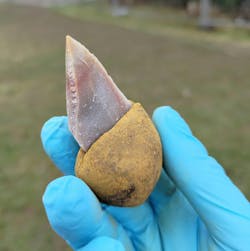
They discovered traces of a mixture of ochre and bitumen on several of them.
“We were surprised that the ochre content was more than 50%. This is because air-dried bitumen can be used unaltered as an adhesive but loses its adhesive properties when such large proportions of ochre are added,” said Schmidt. He and his team investigated this in tensile tests and with experimentally produced reference material.
“It was different when we used liquid bitumen, which is not really suitable for gluing. If 55% ochre is added, a malleable mass is formed,” he shared. It is only just sticky enough for a stone tool to remain stuck in it, but the hands stay clean — so it is a good material for a handle.
A microscopic examination of the use-wear traces on these stone tools, carried out in collaboration with New York University, revealed the adhesives on the tools from Le Moustier were used in this way.
Use of adhesives with several components, including various sticky substances such as tree resins and ochre, was previously known from early modern humans, Homo sapiens, in Africa but not from European Neanderthals.
“Compound adhesives are considered to be among the first expressions of the modern cognitive processes that are still active today,” explained Schmidt.
In the Le Moustier region, ochre and bitumen had to be collected from distant locations, which meant a great deal of effort, planning and a targeted approach.
“Taking into account the overall context of the finds, we assume that this adhesive material was made by Neanderthals,” noted Dutkiewicz.
Adhesives Link Human Evolution
“What our study shows is that early Homo sapiens in Africa and Neanderthals in Europe had similar thought patterns,” said Schmidt. “Their adhesive technologies have the same significance for our understanding of human evolution.”
The idea that the adhesives were used as handles directly attached to stone tools rather than for hafting stone tools to handles lines up with behavior already known from the European Middle Paleolithic — up to about 10,000 years ago.
In their article, the team notes how important this work is for our understanding of the economy and technology of foragers during this period: “They invested time and effort in making compound adhesives and had the cognitive capacities needed. This technology provided new materials with specific and desirable material properties. This capacity and the willingness to invest in tools that represented an elevated cost documents the complexity of late Middle Paleolithic hominin behavior.”
The project, called Ancient Adhesives, runs until January 2025 with €1.5 million ($1.6 million) of funding provided by the European Research Council.
Its overall aim is to create the first reliable method to compare the complexity of Neanderthal and modern human technologies.
About the Author
 Seán Ottewell
Seán Ottewell
Editor-at-Large
Seán Ottewell is a freelance editor based in Ireland. He has an impressive background in the chemical industry. After earning his degree in biochemistry at Warwick University, UK, he earned his master's in radiation biochemistry from the University of London. His first job out of school was with the UK Ministry of Agriculture, Fisheries and Food, London, where he served as scientific officer with the food science radiation unit.
From there he entered the world of publishing. In 1990, he was the assistant editor of The Chemical Engineer, later moving on to the chief editor's position. Since 1998, he has been a regular contributor to European Process Engineer, European Chemical Engineer, International Oil & Gas Engineer, European Food Scientist, EuroLAB, International Power Engineer, published by Setform Limited, London, UK.
Chemical Processing has been proud to call Ottewell Editor at Large since 2007.
He and his family run a holiday cottage in the small village of Bracklagh in East Mayo. He also fancies himself an alpaca farmer.