Podcast: Fail-Safe Pump Technology Wins Vaaler Award
Key Highlights
- The INNOMAG TB-MAG Dual Drive provides true secondary containment through the pump itself, preventing catastrophic leaks of toxic and corrosive fluids.
- Its maintenance-free design eliminates seal replacements, shaft alignments, and oil changes, simplifying operations and reducing downtime.
- The pump's hydrodynamic silicon carbide bearings are wear-resistant, ensuring long-term reliability without the need for intervention.
- Energy efficiency is enhanced by the fully thrust-balanced INNOMAG design and the use of non-conductive carbon fiber containment shells, reducing friction and motor drag.
- The technology is designed for easy retrofitting into existing facilities, requiring minimal modifications and offering a cost-effective upgrade to safety standards.
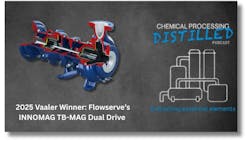




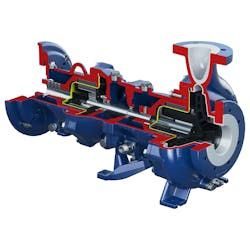
This episode of Distilled features the final 2025 Vaaler Award winner: Flowserve's INNOMAG TB-MAG Dual Drive. This sealless pump technology provides secondary containment through the pump itself rather than the motor, unlike canned motor pumps. The system prevents catastrophic leaks of toxic and corrosive fluids while handling up to 30% solids. Nick Rentzelos, the technology's inventor and Flowserve's director, explains how the maintenance-free design addresses the skilled workforce shortage and stringent safety regulations. The pump features hydrodynamic silicon carbide bearings that don't wear, requires no seal replacement or shaft alignment, and easily retrofits into existing facilities. Energy-efficient carbon fiber containment shells replace traditional metal cans, reducing friction and motor drag while keeping hazardous fluids completely isolated from electrical components.
Transcript
This transcript has been edited for clarity.
Welcome to Chemical Processing's Distilled podcast. The podcast and its transcript can be found at chemicalprocessing.com. You can also download this podcast on your favorite player. I'm Traci Purdum, editor-in-chief of Chemical Processing, and today we're continuing our series of episodes dedicated to the 2025 Vaaler Award winners.
Established more than 50 years ago by Chemical Processing, the Vaaler Awards recognize products and services that dramatically improve the operations and economics of chemical processing plants. The awards honor the legacy of John C. Vaaler, who served as chairman of Chemical Processing's editorial board and editor-in-chief beginning in 1946, following 24 years of distinguished service in the chemical and related industries.
The biennial Vaaler Awards program evaluates entries across multiple categories based on three critical criteria: the significance of contribution to chemical plant operations, novelty or uniqueness of the innovation, and breadth of application across the industry. To qualify for the 2025 awards, products and services must have been commercialized in the United States between May 2023 and May 2025. The panel of judges comprises several experienced engineers working for operating and engineering companies.

Today we're discussing the final 2025 winning innovation: INNOMAG TB-MAG Dual Drive by Flowserve Corp. Unlike canned motor pumps, this technology provides secondary containment through the pump itself, not the motor. This means that in the unlikely event the primary containment fails, the second containment barrier prevents catastrophic leaks while protecting critical components from damage.
One of our judges noted: "It is good technology for highly toxic and corrosive fluids. It can handle 30% solids and is superior to canned pumps. Applicable for most toxic and/or corrosive fluids."
To better understand this award-winning innovation, I want to welcome Nick Rentzelos, director and general manager of Flowserve. Congratulations to you and the entire team at Flowserve, Nick.
Nick: Thank you so much, Traci, and thanks for having us. We're happy to be here.
Traci: I look forward to learning more about this innovation. Start by telling us about your background and your affiliation with the technology.
Nick: I've been with Flowserve for just over a decade. I'm a mechanical engineer by training. I've had several roles within Flowserve, including general manager of the INNOMAG product line, and I like to describe myself as chief evangelist for sealless products within Flowserve. I'm a big believer in their compelling features and benefits for operators around the world. As far as dual drive goes, I am the inventor of the product and the concepts, and I was lucky enough to play a role throughout its entire lifecycle — from conception all the way to commercialization.
Traci: You've certainly earned your evangelistic status. What led to the development of this sealless technology?
Nick: The voice of the customer influences everything we do at Flowserve, and there was a resounding call by many of the world's leading operators for an extra, fully redundant layer of protection for their rotating equipment — more specifically, a better alternative to canned motor pumps to achieve true secondary containment on their chemical process pumps. But really, Traci, beyond that, products like Dual Drive will continue to be conceived, developed and commercialized at Flowserve because they represent who we are as a company. They embody our guiding principle of innovating with purpose and advance our mission statement, which is to provide extraordinary flow control solutions that make the world a better place for everyone.
Traci: You mentioned talking with folks in the industry, your customers. What are you hearing from them regarding pump reliability and challenges they're facing?
Nick: It's a topic that's certainly top of mind. Reliability has always been and always will be a top priority for our customers and operators around the world. What is changing, however, based on what they're telling us, is that finding and retaining skilled maintenance talent is becoming more and more challenging. So now more than ever, many operators are looking for two things: first, maintenance-free pump designs that offer maximum reliability with minimal intervention; and second, pumps with a simple, more user-friendly design that make repairs faster and easier without special equipment or expertise. For many applications, they can find both in products like Dual Drive.
Traci: You mentioned the maintenance-free pump design, and obviously the elephant in everyone's room is the skilled workforce. This is one of the reasons you won this award — because you address that. Can we talk about the pump technology and whether it helps address any specific or new regulations that might be top of mind for folks?
Nick: Sure. There are numerous regulations under OSHA and EPA in the U.S., and even directives like Seveso III and ATEX, that specifically focus on accidental release or loss of containment. We find, unsurprisingly, that major chemical and petrochemical companies, in order to protect their people and their reputations, often maintain internal engineering standards that are even more stringent and conservative than government regulations. Using pumps with secondary containment like Dual Drive — with fully independent containment layers, and importantly, without shared failure modes — helps the facility demonstrate that they've engineered the process to significantly reduce the likelihood of accidental release or loss of containment.
Traci: You mentioned Seveso and the containment issues that happened there — catastrophic. This really addresses that. Talk more about how you're working with your customers to drive home the fact that the safety aspect of this is as important as everything else.
Nick: I'd say it's the most important. The way we work with our customers is we try to explain the potential ways that containment can be breached and what the ramifications can be, and specifically how products like Dual Drive are able to provide preventative measures to make sure that things are fully contained — not only when the equipment is working right. It's one thing to maintain safety when things are working the way they should be. It's a whole different challenge, and I would say a much harder one, to make sure that you have full containment even when things go wrong, even if something fails. That's really the key to go from safe to fail-safe.
Traci: Absolutely. Let's switch gears and talk about any situations or scenarios where this technology may not be ideal. Are there any brownfield plants or older technologies where this wouldn't be compatible?
Nick: Actually, Dual Drive was specifically designed to plug and play into existing facilities without piping or footprint changes. Many customers are installing Dual Drive pumps today onto existing base plates without even having to redrill mounting holes. Dual Drive was also designed to be modular, so you can add that extra, fully redundant layer of protection even to existing mag-drive pumps simply by bolting on a second magnetic coupling. Our goal with Dual Drive was not just to provide a pump with secondary containment, but to make it easy, fast and cost-effective for operators to transform their existing chemical process pumps from safe to fail-safe, as we discussed earlier. Now, it's not a silver bullet. There are plenty of applications that are outside the operating envelope of Dual Drive, but for many applications, achieving this fail-safe condition is very possible, very cost-effective and very easy.
Traci: You talked about the maintenance-free design. Can we talk more about the ease of maintenance?
Nick: It's very simple. Dual Drive is maintenance-free. There's no seal replacement, there's no shaft alignment, there's no impeller adjustment, there's no emissions testing — it doesn't even need an oil change. It has hydrodynamic bearings made of silicon carbide that effectively do not wear. So really it is a set-it-and-forget-it type of product. It fits right into what customers are looking for these days.
Traci: The Ron Popeil of seal technology: set it and forget it. What about some of the energy efficiency advantages?
Nick: Absolutely. There are energy advantages with both the pump and the motor, actually. Dual Drive is based on our INNOMAG design, which is fully thrust-balanced. Having no axial thrust bearings means that the pump operates with less friction and less internal recirculation. More importantly, though, it utilizes high-strength, non-conductive carbon fiber containment shells instead of thin metal cans. Metal cans are not only weaker but also less efficient due to the heat and motor drag created by eddy currents and because of the large gap required between the rotor and stator on the motor side to accommodate that can.
Traci: I want to talk about the significance of separating the motor from liquid containment.
Nick: This one is pretty straightforward, and I'd say it's one of the inherent advantages of Dual Drive over canned motor pumps. As you said at the top of the call, canned motor pumps are also hermetically sealed and also have true secondary containment. But the secondary containment barrier is formed by the motor, not the pump. With Dual Drive, secondary containment is formed entirely by the pump to avoid the inherent safety risks of using an electrical device for liquid containment. The motor, the junction box, the electrical distribution and control systems are all completely isolated, leaving no place for the hazardous fluid to escape.
Traci: Nick, is there anything you want to add that I didn't ask but you think is important for us to understand?
Nick: I think we covered all the key points, Traci. I just want to reiterate how products like Dual Drive exemplify Flowserve's commitment to operator safety. That's really important to us. We treat our own operators and production personnel with uncompromising safety expectations, and we want to help do the same for our operator customers. They're the ones that make it happen. Without those remarkable men and women, our dream of making the world a better place would be just that. So I want to thank all of our customers and all of our operators around the world and offer our assistance in applying our new Dual Drive product to their operations.
Traci: Certainly, enabling folks to go home safe after every shift. And as you've stated several times, safe to fail-safe. You truly are the chief evangelist for sealless technology and for safety. I appreciate the time you gave me today.
Folks, if you want to stay on top of innovation in the chemical industry, subscribe to this free podcast via your favorite podcast platform. To learn best practices and keen insights, you can also visit us at chemicalprocessing.com for more tools and resources aimed at helping you achieve success.
On behalf of Nick and the team at Flowserve that helped propel the INNOMAG TB-MAG Dual Drive to 2025 Vaaler Award status, I'm Traci, and this is Chemical Processing's Distilled podcast. Thanks for listening. Thanks again, Nick.
About the Author
 Traci Purdum
Traci Purdum
Editor-in-Chief
Traci Purdum, an award-winning business journalist with extensive experience covering manufacturing and management issues, is a graduate of the Kent State University School of Journalism and Mass Communication, Kent, Ohio, and an alumnus of the Wharton Seminar for Business Journalists, Wharton School of Business, University of Pennsylvania, Philadelphia.
Recent Awards:
2025 Eddie Award for her column "Lax Regulations Burn Rivers"
2024 Jesse H. Neal Award for best podcast Process Safety with Trish & Traci