Solar-Powered Process Could Cut Energy Use in Epoxide Production
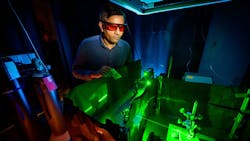
Researchers at the University of Illinois Urbana-Champaign have demonstrated a solar-powered method for olefin epoxidation that could reduce energy consumption and carbon emissions in chemical manufacturing.
Olefin epoxidation produces epoxides used in textiles, plastics, chemicals and pharmaceuticals. Conventional processes rely on peroxide oxidants that generate carbon dioxide and create disposal challenges. Although water can serve as a cleaner oxidant, breaking its strong H–O–H bonds typically requires high temperatures, increasing energy demand and emissions.
The new study, published in the Journal of the American Chemical Society, uses light-assisted electrochemistry to activate water under milder conditions. The research was led by chemistry professor Prashant Jain in collaboration with Susana Inés Córdoba de Torresi at the Universidade de São Paulo and George Schatz at Northwestern University.
“Boosting electrochemistry with light energy, a relatively new concept developed around 2018, was first applied to ammonia synthesis and CO2 reduction with promising results,” Jain said in a statement. “The current study is the result of hypothesizing that this technique could apply to industrially relevant epoxidation reactions. If successful, we knew that our new method could mark a significant advance in both the chemical manufacturing industry and in the study of electrochemistry in general.”
The team used gold nanoparticle “antenna” catalysts paired with manganese oxide nanowire electrodes. When illuminated, the nanoparticles generate energetic charge carriers that weaken water’s O–H bonds, enabling oxygen atoms to be transferred to olefins without high-temperature heating.
“Visible light photons, supplied by laboratory-scale lasers, are absorbed by these nanoparticles, inducing strong electric fields and energetic charge carriers, which weaken the strong O-H bonds in H2O and the double bond in styrene,” Jain added. “The weakened bonds allow O atoms to be plucked out from H2O and added across the double bond to form an epoxide in a marvelous reaction catalyzed by light.”
The researchers said scaling the process will require replacing laboratory lasers with energy-efficient light sources and engineering larger electrolyzer systems suitable for industrial throughput.