South Korean Researchers Develop Wearable Sensor to Detect Ammonia Leaks
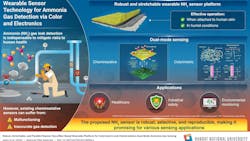
Researchers at Hanbat National University, South Korea, have developed a stretchable, wearable ammonia sensor that combines two detection methods to provide both quantitative readings and an immediate visual warning, according to a study published in Advanced Fiber Materials.
Ammonia is widely used in fertilizers, refrigeration and emerging fuel systems, but it is also highly toxic, making rapid detection critical in industrial settings. Existing sensors typically rely on either chemiresistive or colorimetric detection, each with trade-offs in stability, selectivity or recovery time.
The research team, led by Professor Hyun Il Kang, created a dual-mode sensor built on a gas-permeable polymer nanofiber platform. The design integrates a chemiresistive sensing layer for quantitative measurements with a color-changing layer for instant visual feedback, delivering parts-per-million-level sensitivity and stable performance under humidity and mechanical deformation.
“Our device provides flexibility and facilitates efficient transport of NH3 between the bromocresol-green-based colorimetric and poly(3,4-ethylene dioxythiophene):poly(styrene sulfonate)-based chemiresistive sensing layers,” Kang said in a statement. “This innovative dual-mode design enables reliable NH3 detection.”
According to the researchers, each sensing layer can perform on its own, allowing the platform to maintain accuracy even if one mode fails. The device also operated effectively when attached to human skin and in humid conditions.
Potential applications include personal safety monitoring in ammonia-handling facilities, industrial refrigeration systems, agricultural operations and ammonia-fueled vehicle systems, as well as breath-based health screening. The researchers said dual-mode, skin-mountable sensors could support smart personal protective equipment that provides early leak warnings and improved reliability in real-world conditions.