In good times, demand for products is high and the future looks bright. In bad times, demand falls, plants have too much capacity, and the future looks bleak.
Exactly where on that economic cycle we are at any given moment is anyones guess, but some reports on recruitment at the beginning of the year suggest better times might lie ahead. Chemical giants Dow and DuPont both were planning on at least maintaining their level of hiring of new graduates through 2006. There are specific business segments that are experiencing significant growth, said Sarah Kok, workforce planning specialist for Dow, and they will need engineers to support that.
Nevertheless, we mustnt forget that the chemical industry no longer dominates and drives the employment outlook for new chemical engineering graduates the way it once did. However, major employers in other key sectors such as oil and gas also are still recruiting at reasonable levels. BP, for instance, was looking for 30% more chemical engineering graduates this year than last, because of increased needs in our exploration and production sector, according to Susan Knox Wilson, recruitment marketing manager for BP America, Houston, Texas.
Meanwhile, the aging of the baby boomer generation those born between 1946 and the early 1960s is posing additional staffing challenges to all industry. As boomers now rapidly approach retirement, companies must grapple not only with replacing them, but coping with the loss of their experience.
A supply shortfall?
These snapshots of the recruitment scene, encouraging though they might be to new graduates, are only one side of the supply/demand equation, however. The other side can be seen in a recent survey of CEOs of some of the fastest-growing science and technology companies in the U.S. Commissioned by Bayer. It highlighted the executives concern over the potential shortfall in the number of scientists and engineers coming out of universities (see CP, June).
A similar concern exists about technologists with advanced degrees. We are seeing an unprecedented demand versus supply equation, says Teresa Carroll, vice president of Kelly Engineering Resources, a unit of global staffing provider Kelly Services, Troy, Mich. Anyone with an advanced engineering degree and experience is going to have more than one job opportunity. Right now in oil and gas we just cant find enough people.
Our customers generally are looking for more than just a degree. They look for soft skills, like managing a project or leading a team, she says, and many want years of experience in addition to those skills. But now we have more demand than supply, its very hard to find engineers that meet all those requirements. The longer positions remain open the more likely it is our customers will start looking at [new] college graduates.
But is this concern about a future shortfall in graduates really justified? The last Engineering Income and Salary Survey, sponsored by the National Society of Professional Engineers (NSPE), Alexandria, Va., would suggest not at least if money is the main motivation for students opting for engineering. At an average salary of just more than $46,000 in their first year of employment, entry-level engineers earn more than those entering many other professions. Fledgling chemical engineers earn even more, with average offers in 2005 topping $54,000, according to last years salary survey by the National Association of Colleges and Employers, Bethlehem, Pa.
Weve heard the horror stories about a potential shortage of U.S. engineering graduates, due in part to a perceived decline of job opportunities, says Al Gray, NSPE executive director, but the truth is that engineering continues to be a viable and in-demand profession, and engineering graduates can expect good starting salaries and job opportunities well into the future.
Certainly the current situation for experienced engineers bears this out, judging by the recent CP Salary Survey (April). It drew responses from a variety of technical professionals in the chemical industry, with the majority reporting they generally were happy with salary, benefits and job fulfilment. Almost half of those taking part were chemical engineers. The average respondent was a 47-year-old male with a BS in chemical engineering, who is earning $89,690/yr.
All that paints a relatively rosy picture for any young person contemplating a career in engineering. However, are new graduates really equipped to seize these opportunities? In a recent poll of CP readers, nearly two-thirds of respondents were less than impressed with how well todays new engineering graduates are prepared for a career in the chemical industry. The quality, not quantity, of graduate engineers would appear to be the concern here.
The real world
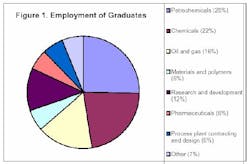
While traditionally many chemical engineers joined chemical companies or refining and petrochemical firms, newcomers to the profession today have a far wider field of opportunities to go after, as highlighted in a survey conducted a couple of years ago by the World Chemical Engineering Council, Frankfurt, Germany. It sought to find out how well a group of over 2,000 young chemical engineers from around the world felt they had been prepared for the workplace or, as the results make clear, workplaces. Although more than half of the respondents worked in the traditional industries, answers came from 27 different industry sectors that now employ chemical engineers (Figure 1).
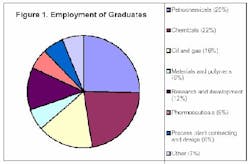
Figure 1. While traditional fields still dominate, respondents came from 27 different industrial sectors. (Click to enlarge).
So, how well prepared were these young engineers? The focus of the survey was not so much on the specific technical content of their courses but more on the general skills and abilities needed for a career as an engineer. The young engineers ranked highly being able to work well in a team, analyze information, communicate effectively, gather information, self-learn and solve problems all the soft skills identified by Carroll.
Refreshingly, when asked to rank the quality of the education received in these and other areas, the respondents came up with a very similar list, but with some notable exceptions. Topping the list of the best-taught skills, for example, was the ability to apply knowledge of basic science and chemical engineering fundamentals, with an appreciation of the potential of research not far behind. Now both of these have long been the traditional priorities of a classical university education, yet the young engineers placed them far down their list of priorities for what would best prepare them for a career.
So perhaps young engineers are well aware of that perceived lack of preparedness picked up by the CP survey. Do the universities share this perception? While no chemical engineering department would admit to sending its graduates out into the world ill-prepared for a career in industry, the changing roles and work patterns of chemical engineers have prompted many schools to start taking stock of how they actually teach chemical engineering and just what form the subject might take in the future.
Evolving education
In 2002, the Council for Chemical Research (CCR), Washington, D.C., held a Chemical Engineering Leadership Workshop, hosted by Steve Miller, CEO of Shell North America, at which many of the arguments for a change in the direction of chemical engineering education were put forward. The consensus according to the summary report was that an understanding of modern molecular biology is vital to the success of future chemical engineers. However, the workshop participants acknowledged that this would call for a major revision of the education given to undergraduates but with that revision would also come the opportunity to revitalize all aspects of the curriculum.
That revitalization is still very much a work in progress, as the program for the upcoming AIChE annual meeting in San Francisco (Nov. 12-17) points up. More than 20 papers are scheduled on tuning the chemical engineering curriculum to meet new challenges and the demands of the job, with eight alone concentrating on the freshman year.
A similar focus on curriculum change was seen at the July 2005 World Congress of Chemical Engineering in Glasgow, Scotland. Although we are clearly interested in students learning fundamental technical knowledge, we are also interested in improving less quantifiable outcomes, such as the ability to think critically and work effectively with uncertainty; to demonstrate effective teamwork and communication skills, said Congress chair Colin Grant of the department of chemical and process engineering at Glasgows Strathclyde University.
While his comments underscore that the issues facing chemical engineering education apply worldwide, Grant specifically highlighted the current work in the U.S. academic community, including the Frontiers in Chemical Engineering Education initiative being run under the auspices of the CCR and with funding from the National Science Foundation. The academics and industrialists behind that initiative have hosted several more workshops in recent years. They envision a future curriculum that will move away from the traditional unit-operations approach and be organized along the lines of molecular processes, multiscale analysis, and systems analysis and synthesis a set of organizing principles or ways to arrange the subject matter of chemical engineering.
Work continues on Frontiers and it might take many years to achieve its goals, but the early signs are promising. The curriculum is already changing dramatically, says Bob Kumpf, vice president of future business for Bayer MaterialScience, Pittsburgh, Pa. Top chemical engineering programs are now doing tissue engineering, white biotech [for industrial processes], green biotech [for agriculture] and red biotech [for medical purposes]. What were seeing is a situation where the top universities have already made these changes, and I think their premise is correct. A chemical engineering department thats stuck in just teaching unit operations is going to be left behind. We need to go beyond the roots of the typical engineering program.
Just how far the colleges are prepared to go remains to be seen, but the bio connection is certainly leading the way. Bio is hot, agrees Phil Wankat, professor of chemical engineering at Purdue University, West Lafayette, Ind., and head of the universitys interdisciplinary engineering division. Most agricultural engineering departments put bio somewhere in their names several years ago. That was considered a survival issue. But will there be more [chemical engineering] jobs if students have a smattering of bio? I doubt it. Will there be more students? Probably. Will students be better prepared for a 40-year technical career if they understand bio as well as chemistry and physics? Of course they will, but you can require a biology course in the curriculum without changing the department name.
Changing perceptions
We will have to wait to see whether any of the proposed curriculum changes can reverse the trend of fewer students opting for engineering. However, Wankat, for one, is not sure that schools can boost enrolment by themselves. We found out in the 1970s that an individual university or even a group of universities can do very little to change popular trends. I think universities and companies and government working together need to show how engineers help people live better lives.
This is certainly one of the goals of Bayers Making Science Make Sense (MSMS) educational program, which aims to improve the general levels of science literacy among pre-college schoolchildren. At the heart of the program, says Pittsburgh-based Sarah Toulouse, who oversees the initiative, is Bayers national volunteer corps of more than 1,000 employees across the spectrum of science and engineering. In the end, its about two things nurturing the next generation of chemical and other engineers and scientists, while at the same time creating a generation of individuals who can read a science-related article in a newspaper and understand it, vote responsibly on an environmental issue, or just prepare a nutritionally sound meal for their family.
Mae Jemison, national spokesperson for MSMS, started her own career with a chemical engineering degree before going to medical school and then becoming the nations first African-American female astronaut. Now CEO of medical-devices company BioSentient, Houston, she says that while many CEOs are rightly concerned about the dwindling numbers of scientists and engineers coming out of colleges, a good proportion have not yet fully made the connection between the potential manpower shortage and the potential untapped talent pool that exists in those individuals who are still not well represented in these fields.
Wankat sums up the problem precisely. If we can become more attractive to under-represented groups and to women, he says, there will be no shortage of engineers. Easier said than done, perhaps, but Bayers Kumpf thinks one of the most effective ways for universities to address the imbalance is through outreach programs school visits, scholarships and awards, anything that engages kids in those formative years when they are deciding what they are really interested in. The bottom line, he says, is that if universities focus simply on recruiting more high-school senior girls and minorities into science and engineering, its already too late. The kids have already made their choice universities need to engage students earlier.
By considering curriculum changes, chemical engineering departments are showing their willingness to engage with the changing demands of employers. Engaging with the other end of the supply chain might be just as profitable to the profession in the long run.