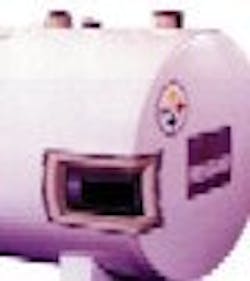
Such tanks showcase the strides made since 1984, when Congress set up the statutory framework for the regulation of underground storage tanks (UST). Also that year, the Steel Tank Institute (STI) introduced the first national construction standard for secondary containment tanks.
However, tank industry technology, as well as the regulatory environment, continues to evolve. This article describes several significant developments that impact the design and operation of storage tank facilities.
Changing mandates
Some states went even further, requiring secondary containment for all USTs. California was among the first to mandate secondary containment for storage of petroleum liquids. Florida and most New England states demand secondary containment for all new USTs. Michigan, Nebraska and New Jersey prescribe secondary containment for any USTs in sensitive areas, such as near certain public water supplies and aquifers.
Other significant regulatory changes have occurred recently and more are in the works.
California now stipulates that all UST systems (tanks and piping) installed on or after July 1, 2003, be impervious to both liquid and vapor of the contained substance. Further, the interstitial space of underground tanks and product piping installed on or after July 1, 2004, must be maintained under constant vacuum or pressure, and any breach in the primary or secondary containment must be detected before the stored substance is released to the environment. Although the language addressing continuous monitoring for tank systems installed prior to July 1, 2004, is less specific, it calls for continuous monitoring "capable of detecting the entry of the hazardous substance stored in the primary containment into the secondary containment." The state also mandates testing of dispenser boxes and sumps, including piping, every three years to verify containment integrity. UST components monitored continuously using vacuum, pressure or interstitial liquid-level measurement methods do not require further testing.
Florida is considering new continuous monitoring requirements for secondary containment piping, including vacuum, pressure or brine systems (European Class I or II options, as outlined later). This is being driven by concern about the more than 175 polyethylene piping incidents in Florida documented by the state's Department of Environmental Protection (DEP); 12% of these resulted in discharges into the environment. Although the majority of the leaks were contained in the piping interstice, the DEP states that more stringent monitoring is warranted. Also under consideration is a stricter standard for an acceptable leak rate than that adopted by the EPA. Both of these measures are at least one year away from publication for comment.
However, more immediate storage-tank rule revisions are underway in Florida. The first changes, simply splitting the current rule into separate ones for aboveground storage tanks (ASTs) and USTs, currently are available for online review. The proposed split rules should be effective on July 1. Others, expected to be drafted this summer, will adopt industry standards developed since the state's last rule change in 1998. The regulations, as proposed, leave intact a 1991 requirement for the use of secondary containment on all existing USTs in the state by Dec. 31, 2009. The deadline for secondary containment of field-erected ASTs is Jan. 1, 2010. (Shop-fabricated ASTs should have had secondary containment by Jan. 1, 1990.)
Other drivers
Even without regulatory mandates, tank owners increasingly are opting for secondary containment because of its tangible benefits. The environmental advantage , additional insurance against product releases into soil or groundwater , is obvious. But secondary containment also provides operational and financial pluses. Operationally, it enables simple and cost-effective leak-detection monitoring. Also, secondary containment gives an added level of protection if a tank were improperly installed or maintained. Financially, it is a bargain compared to potential costs from fines, cleanup, report writing, lawsuits and business interruption should a release occur.STI estimates that nearly 50% of all the steel USTs made in the United States today are secondary containment tanks, compared to about 15% when EPA regulations were first promulgated. This estimate reflects both informal industry surveys and our database of tanks constructed to STI standards. Similarly, double-wall units likely comprise about half the market of fiberglass USTs. Secondary containment predominates in other countries. Mexico, for example, requires all USTs to have secondary containment.
AST activity
A key and long-standing EPA requirement is for the development and submittal of Spill Prevention Control and Countermeasure (SPCC) Plans for all bulk containers larger than 1,320 gal.; a professional engineer must certify the spill plan.
Large tank owners have developed inspection and integrity-testing guidelines: American Petroleum Institute's API 653, "Tank Inspection, Repair, Alteration and Reconstruction." It applies to field-fabricated tanks built to the API 650 construction standard.
Shop-fabricated ASTs typically are manufactured to other standards, such as Underwriter Laboratories' UL 142 or UL 2085. These tanks have smaller capacities, rarely more than 50,000 gal., and, therefore, a lower hydrostatic pressure at the tank bottom. Also, shop-fabricated ASTs are commonly horizontal cylindrical; API 650 tanks are always vertical. The inspection of elevated horizontal tanks markedly differs from that of vertical tanks because the bottom of the tank is visible and, as a result, the tank supports must be checked. Thus, a separate standard for inspection of shop-fabricated ASTs was badly needed.
Consequently, in 2002, the EPA issued a final rule amending the SPCC requirements. The agency prescribed integrity testing and visual inspection for ASTs, both shop-fabricated and field-fabricated, as follows:
"Test each aboveground container for integrity on a regular schedule, and whenever you make material repairs You must combine visual inspection with another testing technique You must keep comparison records In addition, you must frequently inspect the outside of the container for signs of deterioration, discharges or accumulation of oil inside diked areas."
EPA encourages the use of industry standards to comply with the rules. It specifically references STI's SP001-00, "Standard for Inspection of In-Service Shop Fabricated Aboveground Tanks for Storage of Combustible and Flammable Liquids," as one of a number of industry standards that may assist an owner or operator with the integrity-testing and inspection of shop-fabricated tanks. The STI SP001-00 standard includes inspection techniques for single-wall and double-wall shop-fabricated tanks of all types , horizontal cylindrical, vertical and rectangular. It also addresses tanks that rest directly on the ground and those that are elevated on supports. (STI offers a training and certification program for the inspection of shop-fabricated ASTs.)
EPA states that all bulk storage container installations must provide a secondary means of containment for the entire capacity of the largest single container. The secondary means of containment must include sufficient freeboard for precipitation and be impervious to oil. To comply with this requirement, many owners of shop-fabricated tanks have opted for double-wall tanks built to STI or UL standards. EPA has clarified the use of such alternative secondary containment measures (to diking) within a letter that can be accessed on EPA's Web site.
The agency also has revised the applicability of the AST regulation and updated the requirements for various classes of oil and for completing SPCC Plans.
European standards
Developments in Europe bear watching because many tank facility designers and owners have global interests. A common European storage tank standard, EN 12285-1, mandates that all new tanks be double-walled. Closely linked to this standard is EN 13160, "Leak Detection Systems for Tanks and Pipes." That standard describes methods for leak detection, with choice based on risk.
Class I relies on air, either vacuum or pressure, in the interstice. It is considered to be the best system because no product is lost to the environment if a leak occurs. The vacuum approach generally is more expensive. It must provide explosion resistance since vapor can be drawn into the system. The pressure approach, which monitors interstitial pressure and pump performance, can prevent the tank contents from reaching the interstice. However, these pressure systems are designed for European tanks with dished heads; some care is needed to translate the design parameters to U.S.-style flat heads. The vacuum system probably better suits U.S. tanks with flat heads.
Class II involves an interstice filled with an antifreeze mixture and a header tank situated about 3.3 ft. (1 m) above the tank. Change in head of the liquid indicates a leak. Already retrofitted to most UST tanks in Europe, the Class II system is considered to be slightly less "environmentally friendly" because antifreeze can escape if a leak occurs. Also, leak detection failed in some earlier installations when the mixture crystallized. Liquids in use today have been more reliable. However, some countries and individual oil companies are considering banning this method and switching to the Class I system (see below).
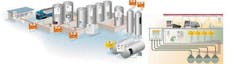
The European Class I leak-detection system uses vacuum pressure in interstice.
Source: SGB
The new buzzwords
Consider, for example, the consequences of water in the system. It can cause myriad problems, from degrading product quality to compromising system integrity. So, operations and maintenance efforts should include a proactive program of monitoring and removing water (Click here for additional information.) Other sensible procedures include periodic tightness testing and inspection of all storage system components , spill buckets, sump boxes, leak detection systems, secondary containment, cathodic protection, system shutdown controls, and so on.
Ensuring maximum component life and functionality should provide sufficient incentives for implementing ongoing system operations and maintenance procedures. However, the regulatory community also is focusing more resources on operational compliance. The EPA is shifting its emphasis from upgrade equipment bean-counting to field inspections, looking for functional compliance of equipment, operations and recordkeeping.
Operations and maintenance are the new buzzwords. The storage tank community cannot emphasize them enough as it strives for ongoing progress in performance and environmental stewardship.
Wayne Geyer is executive vice president of the Steel Tank Institute, Lake Zurich, Ill.