For three years running, according to economists at the American Chemistry Council (ACC), Arlington, Va., the next year was projected to be the turnaround year for the overall chemical business. When growth sputtered in the first half of each of those years, forecasters predicted a stronger second half. And when the year as a whole came up short, the prognostication was for a recovery the following year. A "maana" recovery -- one that will happen tomorrow -- was the term coined by chagrined analysts to describe the frustrating trend.
This time around, though, tomorrow has arrived; some sunlight is peeking through the clouds. Perhaps the greatest reassurance comes simply from the dramatically cyclical performance that the worldwide chemical industry has demonstrated for about the past 10 years (Fig.1). If the bottom of the downturn was reached at some point between the latter half of 2002 and the first half of 2003, we're now in the up part of the cycle.
At the end of 2003, there was a greater sense of confidence that a buoyant business environment will exist. The recent record of quarterly growth in gross domestic product (GDP) -- the best in some 20 years -- is a strong indicator that the U.S. economy is heating up. In nearly all recent years, when the U.S. economy revived, so did the chemical industry, more or less in tandem.
ACC projects a 3.3% growth in U.S. production volumes for 2004, versus an estimate, in its annual year-end survey/forecast, that 2003 will show a 0.3% drop in production volume -- the third year running of decreased chemical production. Shipment values will rise by 4.5%, reaching a new record of $487.7 billion. The turnaround, if it holds up, will be a welcome change for chemical producers. "The past three years have been the worst downturn I've seen in my 35 years of following the chemical industry," says Fred Siemer, head of a same-named financial analysis firm in Highland, N.Y.
Chemical Industry Growth Pattern
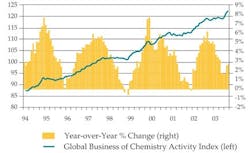
Figure 1:
The worldwide chemical industry has experienced a near-sine-wave pattern of cyclical performance since the early 1990s.It would be premature, to say the least, to break out champagne and celebrate the return of good times in the North American chemical industry. Operating rates are still lukewarm -- in the 78% to 79% range -- making company managers cautious about expanding capacity. "Restructuring," the codeword for shutting plants, selling divisions or cutting employment levels, is still the dominant philosophy among major chemical companies. High, sustained natural gas prices make the raw materials for many petrochemicals expensive. Most significantly, there are signs that chemical industry is in the process of "decoupling" from the overall U.S. economy. Historically, the industry had grown at rates of roughly 1.2-1.5 times the U.S. economy as a whole; now, the ratio is dipping below 1.0, indicating that the chemical industry will not share fully in overall economic growth. These and other factors suggest "that unlike former recoveries, the bounce back won't be as steep and the run-up to the next peak may not be as long," says ACC. "In some cases, it may be years before past peaks in volumes and profits are reached."
Bright spots
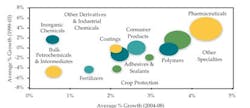
However cloudy the long-term outlook might be, industry managers are welcoming the sunshine on the industry today, simply because the switch from negative to positive production trends represents a reversal of a long and painful downturn.ACC's forecast within specific industry sectors shows that the upturn will take place at different rates (see Fig. 2). Over the 2004-2008 time frame, the highest growth rates will be in pharmaceutical compounds, "other" specialty chemicals, and adhesives and sealants. The lowest growth rates -- 1.0% or less -- will be in bulk petrochemicals and intermediates, and inorganic chemicals.
While commodity chemicals have borne the brunt of the overall economic downturn and feel the pressure from imports most directly, industry is dealing with a painful new reality: the end of a price advantage for natural gas liquids (NGLs) in the U.S., especially in the Gulf Coast. Industry analysts speak of a "secular market change," meaning nothing in the foreseeable future will alter this dynamic. Historically, natural gas was priced at around $2-3 per million BTUs, and gas and NGL derivatives were in comfortable supply. U.S. petrochemical producers based much of their production on cheap gas and were able to supply export markets from the Gulf Coast more competitively than, say, Western European suppliers, who have depended mostly upon naphtha derived from crude oil.
In recent years, gas production has not significantly increased, while demand has surged, mostly from a combined environmental and energy-efficiency policy of promoting the fuel for electric power plants. In the past two years, gas futures on spot markets leaped to $5-6 per million Btus, eliminating the domestic advantage. The result: reduced exports, and shuttered plants in the Gulf Coast. Chiding Washington, William Stavropoulos, chairman of Dow Chemical Co., Midland, Mich., told Wall Street analysts in December that "our national energy policy is simply to pray for cool summers and warm winters."
Dow, along with ACC, for most of the past year has been decrying a natural gas "crisis." Commenting on a report from the National Petroleum Council, Washington, D.C., on natural gas markets earlier this year, Geoff Hurwitz, director of government relations for Rohm and Haas Co., Philadelphia, noted that the NPC report projects a 25% decline in natural gas consumption by the chemical industry. "Most of that decline will come as a result of 'demand destruction,' natural-gas-consuming factories shutting their doors and moving away," he said.
Much of this commentary focused on a new energy-policy bill that Congress was debating this fall. Policy differences stymied passage, but the topic is sure to come up again when Congress reconvenes. However, the solutions that ACC and others propose bring little near-term comfort: expediting permitting for gas exploration and production onshore and offshore on the continental United States, and clearing the way for a new natural-gas pipeline from Alaska to the lower-48 states. ACC has also recommended additional support for developing and implementing new energy-conservation technology, and speeding the permitting of LNG facilities on U.S. coasts. Most of these measures will only gradually relieve the demand crunch, leaving the chemical industry stuck with the current situation for some time.
Dow Chemical, the U.S.'s largest chemical producer (and arguably the world's largest), has already made its adjustments to this new reality. Stavropoulos, in his Wall Street presentation, said that the company is investing in "advantaged feedstock" regions -- Kuwait and Malaysia -- where new ethylene crackers are coming onstream. It has shuttered two ethylene crackers on the Gulf Coast. In addition, the company has cut its energy intensity (the ratio of energy consumption to chemical production) by 30% since 1995 and expects a further 9% reduction by the end of 2005. Finally, it has invested in cogeneration facilities at several locations, and is backing a proposed LNG terminal near Bayport, Texas. Meanwhile, U.S. investment in chemical production has not stopped; the company at its Texas facilities is taking advantage of flexicracker technology, which allows use of either natural gas or naphtha as ethylene feedstock.
Across the range of commodity chemicals, there are areas where the right combination of supply and demand can be exploited, says Rick Smith, an executive vice president at CMAI, a Houston-based market research company. He notes that the economics of chlor-alkali production, which are usually driven by chlorine demand (which, in turn, is driven by demand for polyvinyl chloride) work best when there is a local demand for chlorine. "Integrated facilities, such as exist in the U.S., will have an advantage as the economy rebounds."
Long-term Growth Prospects
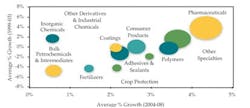
Figure 2:
Chemicals targeted for pharmaceuticals will show the strongest growth, while bulk chemicals will be hard-pressed to keep up with overall economic growth.Global trends
2000 was the last year in which U.S. had a trade surplus in chemicals. In 2003, imports outpaced exports by an estimated $9.5 billion, according to ACC. In 2004, U.S. exports are forecast to improve, reaching a value of $92.5 billion -- helped by a tailwind of the declining value of the dollar. As a result, the trade imbalance will drop slightly, to a projected $8.5 billion.For the world as a whole, ACC projects that production volumes will increase by 3.5% (see Fig. 3). U.S. producers can gain some cold comfort from Western Europe, where chemical companies are dealing with many of the same issues, such as an economic downturn and lack of raw materials. Growth there for chemical production will likely rise only 2.5%.
Every firm today, regardless of where it operates, seems to have a "China strategy," since that country is roaring ahead on all measures: investment, exports, imports. For instance, Dow, BASF, British Petroleum, Huntsman and others are involved in multi-billion-dollar projects under construction. The trend has taken on the appearance of a stampede. "It's an amazing place, and the demand is certainly there," comments market analyst Siemer. But, he adds, "I'm a little worried about intellectual-property issues; I fear that people are going to get burned."
The other hot spot for chemical production is the Middle East where, despite the uncertainties created by a war in Iraq, several countries are moving ahead with partnerships between their national oil companies and multinational corporations. "Ethylene capacity in the Middle East will increase from about 10 million metric tons in 2003 to over 21 million m.t. in 2008, according to our projections," says CMAI's Smith. "All of this will result in additional capacity for downstream petrochemicals in that region."
Business strategies
The chemical industry has been called mature for so long by observers that it might be useful to start thinking of it as post-mature. The hallmark of this phase is that some companies are shifting their focus away from chemicals to "performance products," "materials," "life science" or "consumer goods."The Global Outlook
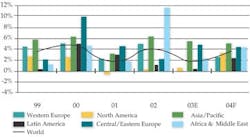
Figure 3:
Asia/Pacific and the Middle East are outpacing other regions in growth of chemical production.In truth, most large multinational chemical producers have been pursuing all of these business goals. The recent business downturn has forced many of them to reassess their portfolios and make hard decisions about what businesses to continue to invest in and which to leave. The past year saw Du Pont -- the inventors of nylon -- sell its fibers business to Koch. Similar restructurings are occurring at Bayer, which plans to spin off its chemical and polymer operations. Dow Chemical, notes chairman Stavropoulos, has not restructured as dramatically as its competitors, but has, over the past 10 years, sold $10 billion in assets, bought $20 billion -- and plans to buy and sell more in the near future.
Where such moves are most strongly felt is in capital spending and R&D, both of which indicate where companies are placing bets for their future. During the past several years, capital spending has declined in the U.S. chemical industry, according to ACC data, but the Council projects a $1.725 billion increase, to $28.75 billion, for 2004. "In the past couple years, capital spending has actually dipped below depreciation levels," notes Kevin Swift, ACC economist.
R&D spending had flattened in the past few years, but didn't show the dramatic declines that capital spending has. ACC data project a 5.0% increase, to $33.4 billion, for the coming year. Much of this spending will be directed toward pharmaceutical or life sciences projects; Du Pont, which retained agricultural and nutrition businesses even as it divested its fibers business, notes that 40% of its recent patents are in life sciences.
Employment outlook
The chemical industry's restructuring has been painful for chemical engineers and other professionals -- and the outlook is not appreciably different going into 2004. Overall employment in the chemical sector (including professionals and hourly workers) dropped somewhat during 2003 to 1.025 million, from 2002's 1.038 million, ACC projects. For 2004, it expects the number of jobs to increase slightly, to 1.027 million. However, "the long-term trend is for employment to continue to decline, though much more gradually than in the past few years," says ACC.However, ACC also projects that the number of "knowledge workers" -- skilled technologists, scientists, technicians and business managers -- is rising in the industry, the result of automation on the one hand, and the R&D-intensive nature of the industry on the other.
The process-engineering director at one major Houston engineering-construction firm notes that such outfits are outsourcing specific tasks to engineering "boutiques." He says that much of this simply stems from the difficulty in justifying fulltime staff for specialty needs. But he adds that there's an implied benefit in this for engineers who are able to develop several areas of expertise, such as process safety or environmental work. He encourages his staff to develop this cross-training expertise, because it provides job security and a better chance to manage specialized work internally for the firm.
College recruitment agencies report that salary offers for new chemical engineers were up slightly last year, averaging around $52,000 for someone with a B.S.Ch.E. degree. The number of B.S. graduates has dropped steadily for the last six years, falling to 5,342 in 2003, according to the Engineering Workforce Commission, Washington, D.C.