Perspectives: Making it Work

TDI Plant Pares Steam Consumption

Thinking differently about energy management leads to substantial savings.

By Donald Pferdehirt, Bayer MaterialScience

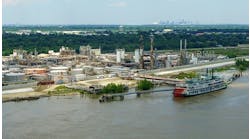
Covering 1,700 acres along the Cedar Bayou at the Gulf of Mexico and having roughly 1,000 employees, Bayer MaterialScience's Baytown, Texas, plant is the company's largest manufacturing site in North America. The facility, which began operating in 1971, traditionally has been a focal point of the company's global manufacturing strategy.

As part of the Bayer Group's commitment to climate protection, the TDI (toluene diisocyanate) Train team in Baytown, in collaboration with colleagues at the Isocyanates Technology Center (ITC) in Leverkusen, Germany, undertook a major initiative to substantially reduce the train's energy consumption by optimizing the operation of equipment.

The team operates the Baytown units that produce TDI, a key raw material for polyurethane, via a three-step energy-intensive process: 1) converting toluene to di-nitrotoluene (DNT); 2) transforming DNT to toluene diamine (TDA); and 3) producing TDI from TDA. Each step involves exothermic reactions and uses distillation to purify solvents and products.

Most TDI manufacturing units at Baytown were built between 1998 and 2000. Steam supply for these units primarily comes from a high-pressure steam network utilized throughout the plant. Additionally, the TDI units can import or export steam via an intermediate-pressure steam network. While several energy-integration measures originally were built into the train, changes at the site, such as adding or shutting down other units, reduced the efficiency of these measures.

Bayer MaterialScience sees great value in sharing information globally. So, personnel from the ITC and team members from operating units worldwide participate in monthly teleconferences and annual face-to-face meetings to discuss issues related to operations at their respective sites. These discussions generated ideas for several energy-saving projects at Baytown that would:

• reduce overall steam consumption;
• allow use of lower-value steam; and
• enable recovery of waste steam.

THREE-STEP APPROACH
To spur people to think differently about the issues, the team took what we call the Energy Management System approach. It has three steps. The first consists of an energy efficiency check and improvement plan aimed at identifying potential savings, categorizing necessary measures and then implementing them. The second step, referred to as Energy Loss Cascade & Performance Indicators, involves visualizing energy losses, reporting the losses and the reasons for them, and setting targets for improvement. The third step, dubbed Online Monitoring & Daily Energy Protocol, comprises visualizing deviations from full-rate operation, optimizing energy use and creating awareness of the steps taken.

Following this approach, the team first studied individual units to identify potential opportunities for energy efficiency improvements. In doing so, it sought to determine if existing measures were fully utilized. If they weren't, the team determined the root cause and evaluated possible modifications. It also studied whether there were additional uses for reaction heat, and reviewed distillation efficiency and the solvents used with an eye toward seeking more-energy-efficient choices.

Furthermore, the team assessed the interactions between the TDI units and other areas of the plant. This was done to:

• determine energy needs and potential to supply across the entire site (for example, utilize the heat of the reactions);
• compare total volumes of steam sources of all pressures available for potential use in other units; and
• develop means to modify existing steam supplies to meet needs of units.

As part of this effort, the TDI energy officer monitored energy usage daily and made modifications to optimize unit conditions. In addition, for immediate optimization, operators got access to online models that were developed to compare actual to theoretical best usage.

Based on its findings, the team implemented several TDI Train energy improvement projects.

For example, one effort involved using process simulation tools to evaluate different heat-integration configurations, leading to greater energy efficiency.

The team also conducted cooling-tower load studies. The findings led to consolidating two cooling towers into a single operation, providing additional opportunities for increased efficiency.

Another noteworthy project resulted in installation of an additional steam educator on existing equipment. The original educator only could work at high operating rates; the second educator provided the ability to reduce steam usage across the entire operating rate range.

The site saved 243,000 tons of steam between 2008 and 2010 through these modifications. The reduction in natural gas consumption for steam generation equals the demand of 17,000 American households for a year. Furthermore, the site was able to decrease the amount of steam needed from an outside supplier by approximately 20%.

Besides lowering operating costs, the energy savings projects provide the equivalent of reducing CO2 emissions by approximately 47,450 tons per year.

Additionally, the site achieved a 50% reduction of the energy intensity in one of the units.

In recognition of its efforts, the Baytown TDI Train team received the American Chemistry Council's Responsible Care Energy Efficiency Exceptional Merit award.

The ITC continues to investigate and develop energy savings measures that are applicable across many sites/units, and teams worldwide continue to gather best practices from other sites for implementation at Baytown. The site has formed the Baytown plant energy community to monitor changes to the overall energy balance and look for additional opportunities to improve.

Further, the Energy Management System approach will be fully implemented by the end of 2013 in most Bayer MaterialScience energy-intensive production facilities (those accounting for 85% of energy consumption). This should lead to additional opportunities for optimizing operations and costs.


DONALD PFERDEHIRT formerly was TDI production lead, Bayer MaterialScience LLC, Baytown, Texas, and now is TDI train program manager at the Bayer MaterialScience site in Shanghai, China. E-mail him at Donald.Pferdehirt@bayer.com.

More from this perspective...

Title

Chemical Facility Relocation Prompts Safety Moves

Massive project pioneers enhanced safety standards for construction.

04/25/2013

Hydrogen Plant Cuts Fuel Consumption

Switch to structured foil catalyst also promises to extend furnace tube life.

02/13/2013

Versatile Fittings Enhance Pilot Plant

Variable positioning of probes and dip tubes provides flexibility and savings.

01/24/2013

Biorefinery Beckons: Plant will produce ethanol from corn stover

Iowa facility will be one of the first and largest commercial biorefineries in the world.

01/03/2013

Chlorine Process Pares Power Use

Oxygen depolarized cathode technology nears commercialization.

11/15/2012

Bleach Producer Cuts Cooling Costs

Plastic cooling tower provides maintenance and energy savings.

09/10/2012

Low-Cost Monitoring Protects Pricey Pump

Wireless pH analyzer provides crucial insights on seal integrity.

08/13/2012

Phosphate Plant Boosts Safety and Production

Ultrasonic metering minimizes acid leaks and allows real-time control.

05/21/2012

Watch Out for Trapped Components in Towers

Buildup can prompt erratic performance of distillation columns.

03/27/2012

Plant Pares Water Use and Disposal Costs

Process changes save water and improve water treatment.

02/27/2012

Modeling Speeds Capacity Expansion

Simulation allows evaluation of more options more quickly.

02/02/2012

Chlorine Plant Benefits From PEM Fuel Cells

Skid-mounted stacks convert hydrogen directly into electricity.

12/05/2011

Ethanol Plant Boosts Operating Margin

Model predictive control enables plantwide optimization.

10/27/2011

Nonlinear Models Enhance Distillation

Production-data-based approach leads to improved efficiency of rosin column.

10/04/2011

Multi-Facility Approach Provides Clarity

Linking automation KPIs to business value identifies priorities for action.

08/13/2011

Case Study: Digital Positioner Aids Air Separation

Tighter control enables significant boost in argon output.

07/25/2011

Mixer Seal Gets Major Makeover

Novel retrofit prevents leaks and offers other benefits.

06/02/2011

Digital Valve Controller Provides Lasting Savings

Linkage-less non-contact unit successfully copes with vibration.

05/18/2011

Online Analytics Improves Batch Operations

Field trial shows value for fault detection and quality prediction.

03/29/2011

Clamp-on Flow Meter Gains Firm Hold

Site finds ultrasonic device provides easy installation and accuracy.

01/27/2011