Material Handling: Ensure Proper Silo Design
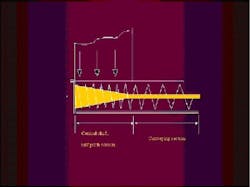
This article discusses the flow problems that occur when handling chemicals and other bulk solids in silos and tanks. It also delves into how to avoid some of these flow problems and discusses topics such typical flow patterns and solids flow properties.
The impact of improper design
A poorly designed silo is the natural outcome of an inadequate understanding of the solid being stored. Five possible conditions will occur as a result: no flow, erratic flow, flooding, counter-current air flow and segregation.
Clearly a no flow condition negatively affects your process. This condition can occur when you try to initiate flow by opening a gate or starting a feeder. Two problems can occur: an arch or a rathole can form [1] (Figure 1).
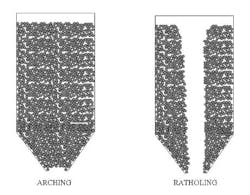
Figure 1. Two types of conditions cause solid flow to stop completely.
An arch (bridge, dome) can form over your outlet. This arch is capable of supporting the entire contents of the silo above. Extreme methods may be required to initiate flow. Gravity flow is desired as gravity requires no maintenance; however, flow aid devices, such as sledgehammers, vibrators, and air blasters, may be required to assist gravity.
The second no flow condition occurs when a stable rathole (pipe, core) forms. Some material typically discharges through a preferential flow channel; however, because of a materials cohesive strength, the flow channel empties out resulting in a stable rathole and no flow.
Erratic flow develops when a silo experiences both ratholing and arching. What usually happens is that flow is initiated and a stable rathole develops. To maintain flow, you are required to collapse the rathole by use of some flow aid device. The collapsing material arches as it impacts the outlet and flow has to be re-initiated until a rathole forms again and the scenario repeats. Erratic flow can affect the structural integrity of the silo or tank.
Some fine powders can easily flood from silos. If a stable rathole forms and additional material is added or falls into the channel from above, the falling material becomes fluidized or aerated in the channel. The feeding device at the outlet, which is designed to discharge a bulk solid under control, cannot control a fluid and the product floods from the silo.
Fine powders oftentimes exhibit limiting discharge rates, typically because of counter-current airflow. This flow rate limitation is a function of the materials permeability. Flow rate limitations typically develop because of a vacuum that is created as material flows in a hopper. Air or gas from the outlet flows counter to the material to satisfy this vacuum, causing a flow rate limitation. The usual approach to solve this type of flow problem is to increase the speed of the feeder. However, the powder cannot flow any faster through the outlet, so increased feeder speed wont help.
Segregation problems occur in many industries. This happens when a solid composed of a range particle sizes or densities separates. The major cause is sifting, where fine particles sift between coarse particles. As an example, upon forming a pile of material with differing particle sizes, typically the fine particles would concentrate under the fill point while the coarse particles would roll or slide to the outside. There are several other mechanisms of segregation that can be troublesome if uniform density or mixed material is required for a process.
The implications
Its worth considering the production troubles spawned by inconsistent flow from a silo. This is especially important when expensive improvements like a variable pitch conveyor are considered for the bottom of a silo to improve flow. These troubles can include: reduced live storage capacity, spoiling or caking of a product, and vibration, which in turn can damage weigh cells and other delicate instrumentation and even lead to structural failure of the bin itself.
Spoilage or caking can occur due to stagnated material that resides in the silo for days, weeks, months, and even years. Because this product remains stagnant, agglomerates can form, bacteria can grow and chemicals can react. If a product gains cohesive strength after storage at rest, it can cake, not only creating flow difficulties but also an undesirable product for your customers.
As bridges and ratholes collapse, they expose the silo to excessive vibrations. Imagine that a product has ratholed. Suddenly, this rathole collapses either on its own or due to some external force. The volume of material that impacts within the silo can cause significant vibrations, which may eventually affect its structural integrity.
Silos have unfortunately failed. Failure due to vibrations is just one area of concern. A preferential flow channel can expose the silo to asymmetric loads. These loads can easily be great enough to cause dents in the silo sidewalls or even collapse the vessel.
Preventing problems
To avoid the flow problems mentioned earlier and their effects, you must measure your materials flow properties. Second, you must be aware of the type of flow pattern that develops and, last, you must ensure reliable feeder design.
There is a battery of tests that will help you identify materials flow properties. Property tests will identify, prior to equipment fabrication, just how a solid will flow in a particular geometry [2]. The validity of a proposed geometry can be confirmed by determining a materials cohesive properties, wall friction properties, and compressibility and permeability values.
Measuring a materials cohesive strength allows you to determine opening sizes to prevent arching and ratholing. Cohesive strength is a physical, chemical, or electrical bond that causes a flow obstruction to occur. Many bulk solids when poured from a container will flow like a liquid. Under these conditions, the material has no cohesive strength. However, when the solid is squeezed in your hand, it may gain enough strength due to compaction to retain the shape of your hand.
Cohesive strength is measured using a bench scale laboratory testing device such as a direct shear tester such as a Jenike Shear Tester [2]. This device determines a materials Flow Function (strength/pressure relationship). The materials cohesive strength is measured as a function of applied consolidation pressure. A sample of the material is placed in a shear cell on the direct shear tester and both compressive and shear loads are applied to simulate flow conditions in a silo. Dr. Jenikes Bulletin 123 includes the testing procedure and proper silo and feeder design technique using design charts given in the Bulletin [3].
Once the material in the shear cell is consolidated, its strength is measured by shearing it to failure. By repeating this procedure under varying loading conditions the resulting value of strength versus consolidating pressure can be determined. The process is fairly straightforward; however, it takes quite some time to simulate the range of pressures acting in a silo.
This test procedure allows you to simulate several other conditions that affect material flowability. The samples moisture content and particle size can be controlled while the direct shear tester allows simulation of the effects of temperature and time of storage at rest on the sample. The test results yield opening sizes to prevent arching both in conical and wedge type hoppers.
Values of wall friction are expressed as a wall friction angle or coefficient of sliding friction. The lower the coefficient of sliding friction, the less steep the hopper walls need to be to ensure mass flow. The coefficient of sliding friction can be measured using the Jenike Shear Tester by determining the force it takes to slide a sample of solid across a stationary wall surface. The friction that develops between the wall surface and bulk solid resists this force. Once wall friction angles are measured, hopper angles for mass flow are determined.
Compressibility is a range of material bulk densities that vary as a function of consolidating pressure. Solids exhibit a range of bulk density that depends on the consolidation pressure being applied by the material in the silo. Compressibility values are used for calculating hopper angles and opening sizes and also silo and feeder loads.
A materials permeability is determined by passing air or other gas through a representative column of bulk solid, typically a fine powder. The rate at which the gas flows is measured, while the pressure across the bed is regulated. This approach allows the permeability of the bulk solid to be determined as a function of its bulk density. Permeability values are used to calculate critical, steady state discharge rates through various size outlets in mass flow silos. The silo outlet can then be modified to accommodate your required discharge rate.
Know your flow pattern
An understanding of the flowing properties of your solid will go a long way towards establishing consistent flow from your silo. Once you understand these properties it is time to define the flow pattern. If you have an existing flow problem, you likely are developing a funnel flow. If you are designing a new bin or silo, you most likely require a mass flow pattern.
A funnel flow pattern exists when some of the material in a silo moves while the rest remains stationary. The walls of the hopper section are not sufficiently steep or smooth enough to force the material to flow along them. The friction that develops between the silo hopper walls and material inhibits sliding, which results in the formation of a narrow flow channel usually directly over the outlet. The first material that enters the silo is usually the last material out the first-in/last-out type of flow sequence. If the material has sufficient cohesive strength, it may bridge over the outlet, or if the narrow flow channel empties out, a stable rathole will form.
Funnel flow silos are suitable for coarse, free-flowing materials that dont degrade. They can also be used when segregation is not important. For example, most plastic pellets would typically be suited to funnel flow applications. Cereal grain wouldnt be suitable for funnel flow.
The major benefits of a funnel flow silo are reduced headroom requirements and lower fabrication costs for the silo. That usually means that shallow cones; 60° or less from horizontal, pyramidal hoppers, and flat-bottomed silos are used. Although construction costs will be lower, maintenance costs and downtime will quickly eclipse savings. Problems with material flow usually far outweigh savings because most fine powders dont flow well in funnel flow and experience all the flow problems discussed previously.
A mass flow patterns exists when all the material is in motion whenever any is withdrawn. Material slides along the hopper walls because they are steep and smooth enough to overcome the friction that develops between the wall surface and bulk solid. The hopper outlet must be large enough to prevent arching; mass flow wont prevent arching. It also is important to note that stable ratholes cannot form in a mass flow silo. Because of this, mass flow silos are suitable for cohesive solids, fine powders, materials that degrade or spoil, and solids that segregate.
The flow sequence for mass flow is first-in/first-out, which allows a silo to store a solid that degrades with time. Mass flow is beneficial for powders; flooding of powders can be avoided as long as the residence time allows for deaeration. Particle segregation is minimized as the fines and coarse particles are reunited at the outlet. Typically, steep cones and wedge shaped hoppers (chisels, transition hoppers, etc.) are used to ensure mass flow (Figure 2).
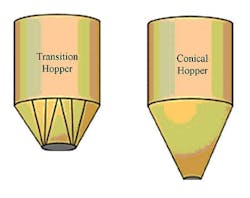
Figure 2. Characterizing the flow properties of solids will allow you to avoid problems.
The importance of feeder design
It is easy to underestimate just how important feeder selection can be for reliable material flow. You must select a feeder that not only controls flow but works well with your silo. You can go to great lengths to have your materials flow properties evaluated in order to develop the proper flow pattern; however, you can destroy this effort simply by using an improperly designed feeder. This can be an expensive mistake because you may have used a special liner and/or steep hopper to generate mass flow.
The silo and feeder design go hand-in-hand so that for the feeder to work in unison with the silo, it must:
- Suit the materials flow properties;
- Fit into the silo outlets shape, allowing material to flow uniformly across the outlets entire cross-sectional area;
- Minimize loads the material applies to the feeder; and
- Accurately control the discharge rate.
Several options are available for feeding from a silo. These choices narrow once the flow characteristics of a material are understood.
One option to consider is the slot. Slot outlets are common when designing bin and hoppers for reliable flow. A slot configuration (or wedge type hopper) offers several benefits over conical hoppers, such as shallower angle requirements for mass flow, smaller width openings and higher discharge rates. With a slot opening, a screw feeder or belt feeder is typically used to control discharge rate. It is critical that the feeder increase in capacity in the discharge direction, in order to maintain flow from the entire slot opening. With screws, the capacity of the screw flights increases in the discharge direction (Figure 3).
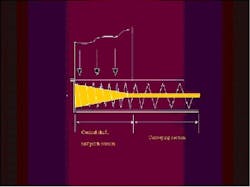
Figure 3. This type of silo is best suited for cohesive or fine solids, and solids that segregate or spoil.
With belts, we design an interface to the belt as shown to provide the required increase in capacity (Figure 4).
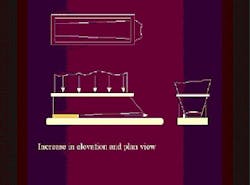
Figure 4. A variable pitch or conical screw conveyor can provide even flow across the bin area.
In summary, the flow properties of your material determine whether mass flow is required to overcome the problems experienced with a funnel flow design. Once flow properties are determined and analyzed, the proper silo design can be established. Your silo manufacturer should have the capability to provide the above services to you. This approach will minimize silo startup problems and provide years of useful service in the field.
Bibliography
- J. A. Marinelli and J. W. Carson, Solve Solids Flow Problems in Bins, Hoppers, and Feeders, Chemical Engineering Progress, (May 1992).
- J. A. Marinelli and J. W. Carson, Characterize Bulk Solids to Ensure Smooth Flow, Chemical Engineering, (April 1994).
- A. W. Jenike, Storage and Flow of Solids, Bulletin No. 123, University of Utah, Engineering Experiment Station, Salt Lake City (Nov. 1964).
- Joseph Marinelli, Choosing a Feeder That Works in Unison with Your Bin, Powder and Bulk Engineering, (Dec. 1996).
Joseph Marinelli is president at Solids Handling Technologies, Inc. in Ft. Mill, SC ; Email him at [email protected].