Choose the right temperature sensor
There’s no simple solution to achieving accurate temperature measurement. It’s a combination of knowing the inherent accuracy of particular sensor types, and how environmental factors can create further measurement uncertainty and the sensor calibration techniques available to reduce this uncertainty.
Thermocouples
Thermocouples are the smallest, fastest and most durable temperature measurement solution. They can withstand very high temperatures, harsh mechanical punishment and are simple to operate. Their size allows for rapid temperature response times and the sensing junction can often be placed very close to the desired point of measurement. The durability and simplicity of this sensor type makes them ideal for embedding into devices or equipment.
However, the thermocouple is most at risk from accuracy, noise and precision error. When extreme accuracy and precision is required, many of these shortcomings can be ameliorated by good engineering practice. These include: using short runs (less than 500 ft., certainly less than 1,000 ft.), assuring that thermocouple wire is insulated and shielded, avoiding extra wire terminations, keeping wire away from high voltage equipment, and increasing the gauge of the wire. When greater accuracy is needed, some success has been found by using balanced, low-pass filtered differential amplifiers (to avoid common-mode voltage offsets), and following relatively complex calibration procedures. A common problem with thermocouples is manufacturing mistakes.
Lack of alloy homogeneity in thermocouples presents additional challenges. Deviations in metal purity and alloy homogeneity increase wire resistance resulting in deviating from the National Institute of Standards and Technology (NIST) standards. Longer runs of wire increase the chance of this type of problem. Some thought also should be given to materials selected for insulation and how the wire is shielded. When high accuracy is required, without calibration, a thermocouple type that consists of a minimum number of elements like a type T, J or G should be used.
Thermistors
Thermistors are ideal for applications requiring a balance of high sensitivity, accuracy and responsiveness. However, they are usually limited to a relatively narrow range of temperatures (typically less than 300˚C). Unlike thermocouples, thermistors cannot endure high temperatures or mechanical stresses, which makes them difficult to use in applications and assembly operations where these influences are not well controlled. To compensate for this limitation, the sensor can be encased in a protective metal enclosure — but this will be at the cost of thermal responsiveness. Some special thermistors are capable of working to temperatures of 1,000˚C.
Local signal conditioning is recommended for thermistors. Fortunately, it is much simpler than conditioning required for thermocouples. Thermistors tend to be larger than thermocouples, resulting in correspondingly slower responses — but faster than RTDs. Likewise, size can reduce their accuracy because they cannot be located as close to the point being measured as equivalently placed thermocouples. For thermistors, other accuracy problems exist.
Near athermistor’s maximum sensitivity point, small changes in temperature produce relatively high changes in resistance: a non-linear response. Away from the maximum sensitivity point, thermistors are less able to resolve changes in temperature. Padding resistors may be added in a voltage divider circuit to obtain a more linear response. As with thermocouples, there are some manufacturing problems.
Thermistors can be made relatively uniform in batches, but batch-to-batch variations can be problematic when high precision or accuracy is required. Additionally, there are no NIST standards for thermistors, so there may be additional manufacturer-to-manufacturer response variations.
RTDs
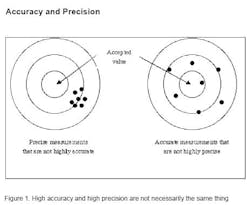
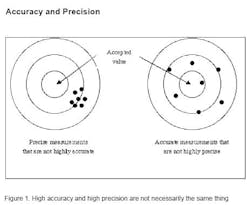
RTDs are suitable when extremely stable and precise measurements are required, because they have less drift than other elements. They are usually the best choice when accuracy over a prolonged time is the most important quality. The accuracy and precision of RTDs often exceeds that of both thermistors and thermocouples. Accuracy is a measurement against a measurement by a superior, calibrated device. Precision is a statistic of repeatability (Figure 1). RTDs follow Deutsche Industrie Normen (DIN) and Joint Information Systems Committee (JISC) national standards.
There are fewer manufacturing problems with RTDs. With good tolerance specifications, off-the-shelf RTDs are very consistent regardless of their batch number. RTDs are very delicate. While the melting temperature of an RTD element is sufficiently high to survive many high-temperature manufacturing operations, they do not survive aggressive mechanical operations, such as compaction. It is difficult to embed RTDs into custom mechanical devices. Using metal-sheathed assemblies can protect the RTD but at the cost of response time and bulkiness. For example, Watlow manufactures cartridge heaters with embedded thermocouples. Insulation material is compressed around the thermocouple at very high pressure — called swaging. Attempts to achieve greater accuracy with an RTD have failed because they are too fragile to survive this process.
For a typical 100-ohm RTD, resistance from long lead runs and multiple terminations can become a significant source of error. This is also true for thermocouples; but it is more difficult to overcome the resulting effect on thermocouple accuracy. This is not true for RTDs. Changing from a two-wire to three- or even four-wire RTD can greatly improve accuracy. The electronics can be constructed to dynamically remove error associated with lead resistance, but there is also a trade-off in terms of cost and the number of wires required to perform the measurement. Another consideration is the environment: only the two-wire configuration is intrinsically safe.
Noise from external sources can create additional measurement problems, but can be mitigated in much the same way as thermocouples — by using differential, ungrounded, and shielded elements. These effects can also be limited by optional electronics that perform 10%-duty cycle measurements to limit self-heating power without reducing signal strength. However, the trade-off for utilizing low-level signals (power) to drive an RTD is that measures may be required to minimize the effect of external noise.
Sensor considerations
When building your knowledge base on sensor types, be sure to consider inherent accuracy for durability, range of operation, and susceptibility to external noise influences. Other considerations include: sensor temperature limits compared to process requirements (limits should bracket process range), the required level of accuracy and repeatability, ease of maintenance and installation, handling during installation (delicacy), ease of calibration, and the type of environment it will be used in.
An awareness of the inherent accuracy of particular sensor types is important, but is only part-way down the path to optimization. Knowledge of sensor placement, the effects of environmental factors on sensor error, and calibration techniques that improve precision, that ultimately leads to optimum sensor selection.
Location and transient errors
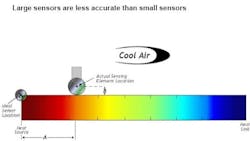
It is nearly impossible to sense temperature exactly where you need it. The sensor itself has a finite size that displaces the sensing element from the ideal position for accurate measurement. Thermistors and RTDs are at greater risk for location error than an equivalently placed thermocouple — simply because of their size. In general, where a measurement must be pin-pointed, thermocouples are superior to both RTDs and thermistors (Figure 2). Thermocouple wire as small as 0.04 in. in diameter is available. Location error ‘A’ in the figure is a direct result of the entire sensor being displaced from its desired location; orientation is also a factor, especially at high temperature where the majority of heat transfer is by radiation. If surrounding heat sources and sinks are known, compensation can reduce the location error. However, this can be difficult in many systems because the understanding of the effect of sinks and sources may be unclear. When in doubt — use the simplest solution. Avoid complex calibration techniques and install the smallest sensor available as close to the temperature source as possible.
Transient errors are dynamic thermal errors. Typically, it is difficult to compensate for these errors — every material within the thermal system has its own unique thermal conductivity and capacity. For example, the thermoplastic covering thermocouple wire expands differently than the wire, which affects the resistance of the wire — aging affects the wire and the covering. Of the three most popular sensor types, it is the thermocouple that best minimizes transient errors because it is the smallest sensor with the smallest time constant.
Heat transfer error
Sensors receive conductive, convective and radiative inputs that contribute to measurement inaccuracy. This error can occur along a specific pathway, as when an electric wire of a sensor is heated by a nearby heat source. The measurement is thereby distorted. Heat transfer error affects thermistors, RTDs, and thermocouples. E and J thermocouples use alloys that are less conductive, which makes them ideal for mitigating this kind of error. When electrical resistance produces heat inside a sensor it causes a false-high reading — this is called “self-heating error.” This error applies to thermistors and RTDs only. The self-heating error is insignificant in flowing streams but can be a serious in static measurement. Strategies for minimizing this include keeping the current low or pulsing the sensor with a low duty cycle to keep the average power dissipated in the sensor low.
Atmospheric and environmental influences
All sensors are affected by aging, especially those in cyclic service, or when they are operated near their temperature limits. Material deterioration causes a drift from the initial profile (e.g., resistance increases). Thermocouples exhibit more complex behavior because the voltages produced are a direct result of the resistance difference between two dissimilar metals. Thermistors and RTDs are usually well-sealed from the environment making them less susceptible to internal corrosion. Thermistors usually exhibit some initial drift, but are generally stable after initial aging. Although sensors may be sealed, lead wire deterioration or corrosion is a problem regardless of sensor selection.
RTDs have a distinct advantage over other sensors. For RTDs, lead-wire corrosion problem is mitigated by using 3-wire or 4-wire units that effectively measure the resistance of the sensing element, versus the connection wire. With this type of installation, the RTD has the greatest overall stability of the three sensor types.
The effect of moisture on sensors is complex. For example, forced air flow on and around a sensor measuring a surface temperature will lead to heat transfer error. Convective currents add or remove heat from the sensor and measurement surface. If the atmosphere is at a different temperature than the surface, or the measurement environment is moist, the heat flow associated with convection must be considered as if it were another heat source or sink.
Mechanics and related effects
Small gage wire and fragile sensors should be avoided in applications that subject them to extreme mechanical motion, vibration or high-intensity acoustics. The most common wire failures occur near connection points, where there is the greatest amount of flexure. For example, a thermocouple wire is most vulnerable where it is bare wire in a process or in a thermowell. In addition, mechanical motion or vibration can stimulate internal resonances inside the sensor — leading to early failure. Thermocouples are generally the most durable of the three sensor types because many of the alloys used in the wires are more ductile — allowing them to handle additional motion. However, cold-working can increase the resistance of thermocouple wire, especially, in small wire.
Besides fatigue, cables in motion can also generate low- voltage triboelectric effects. For microvolt sensors — such as thermocouples or RTD’s — these effects could contribute to inaccuracy. This error can be significant if the motion stimulating the effect is of the same order as the thermal responsiveness you intend to measure.
Magnetic and other issues
Thermocouples and RTDs are susceptibility to noise; thermistors are more immune. By shielding and properly grounding, immunity from potential noise can be improved. These methods work well for noise from capacitance currents, radio frequencies and offset currents. Immunity from magnetic sources is not so easily achieved.
Sensors often operate in areas containing large motors, solenoids, or high current devices. This equipment can cause transient currents or magnetic surges. For sensor types that require stimulating electronics (thermistors and RTDs), these power droops can affect the power supplies and sensing circuits inside the sensor electronics, which subsequently affects temperature readings. Additionally, large inductive spikes can create circulating currents that alter ground potentials near the sensors — biasing the voltage and causing sensor error.
When thermistors are used to measure temperatures near their lower extremes, the resistance may approach 100K or more. When this happens, long runs of thermistor wire can create an antenna that adds noise to the measurement system. While most of this can be filtered out, the potential for biasing the measurement becomes greater because the direct current charge collects noise (known as the electret effect).
The best method to protect from outside electrical and magnetic sources is to keep the sensor and lead wires away from them, shield them, and pay close attention to electronics isolation and grounding — only a few feet can make a big difference! Keeping sensor lead wires short and converting the signals into digital form, as close to the measurement point as possible, can also help minimize noise.
Sensor calibration techniques
There are two ways to calibrate sensors to correct for inherent errors: a controlled isothermal bath (usually water) or a point calibration. The controlled bath is highly accurate and allows for multiple points. However, it is limited to the physical range of the liquid in the bath. In the point method the sensor is immersed in a liquid/solid bath — a standardized melting point — an ice bath (0.01°C) or a gallium bath (29.7646°C) are good examples. This method is only as sound as the ability to extrapolate, or interpolate, from the measurements.
If only relative accuracy is acceptable, an array of sensors can be calibrated against each other by immersing them in a common bath at a known temperature (0˚C for an ice bath). The temperature in the bath can then be slowly raised, while tracking all sensor responses. To achieve the best results, the calibration bath should span the same temperature range as the intended measurement. Additionally, the rate of temperature increase should be slow, relative to sensor responsiveness, which will reduce time-transient errors.
The limiting factor for minimizing inherent sensor error is the uncertainty (including both the accuracy and precision) of the calibration process. Generally, thermistors and RTDs have better inherent accuracy than thermocouples, but all three types of sensors will require calibration to achieve accuracies down to 0.1˚C. It is more challenging to calibrate thermocouples than thermistors and RTDs — calibration must consider both hot and cold junction temperature errors.
Putting it all together
Sensor selection goes beyond having a sound knowledge of the inherent accuracy of particular sensor types. In selecting the best sensor for an application, environmental factors must also be considered for potential sources of error. It is also important to be familiar with the strategies that can be used to minimize environmental influences. Table 1 compares all three sensor types.
Cal Swanson is a senior principle engineer at Watlow Electric Manufacturing Company, St. Louis, MO. E-mail him at [email protected]