Know Your Flow
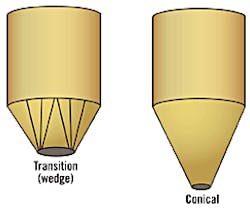
Powder flow is, indeed, a science. The field of bulk solids handling was developed mainly through the work of Dr. Andrew W. Jenike, who pioneered bulk solids flow theory. In the 1950s, Jenike developed a scientific approach to the storage and flow of bulk solids that is still relevant today. In fact, the Jenike shear test is now the American Society for Testing and Materials (ASTM) standard in the United States and Europe for determining a powder's cohesive and wall friction properties.1
Typical flow patterns
To avoid flow problems, you first must understand the flow patterns that can develop in a bin or silo. Second, to identify a flow pattern, you must have knowledge of material flow properties and be able to apply that knowledge.
Funnel flow
occurs when some material in a bin moves while the rest remains stationary. The walls of the hopper section are not steep enough or smooth enough to force the material to flow along them. The friction that develops between the bin hopper walls and the material inhibits sliding, resulting in the formation of a narrow flow channel, usually directly over the outlet.The first material entering the bin usually is the last material out (first-in/last-out flow sequence). If the material has sufficient cohesive strength, it can bridge over the outlet or, if the narrow flow channel empties out, a stable rathole could form. This stable rathole can:
Decrease the bin's live or usable capacity.
Result in stagnant material that can cake or spoil.
Heighten segregation problems.
Cause structural failure.
Two common funnel flow bin designs are shown in Fig.1.
Figure 1. Funnel Flow Bins
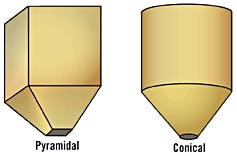
Funnel flow bins are suitable for coarse free-flowing materials that do not degrade.
Funnel flow bins are suitable for coarse free-flowing materials that do not degrade. They also can be used when segregation is not important. For example, plastic pellets typically are suited to funnel flow applications.
The major benefits of a funnel flow bin are reduced headroom requirements and lower bin fabrication costs. Shallow cones (60 degrees or less), pyramidal hoppers and flat-bottomed bins exhibit funnel flow.
Most funnel flow bins are designed to save height and/or cost. However, flow problems for materials such as fine powders can far outweigh the size and cost benefits.
Mass flow
occurs when all the material in a bin is in motion during withdrawal. Material slides along the hopper walls, which are steep and smooth enough to overcome the friction that develops between the wall surface and bulk solid.The hopper outlet must be large enough to prevent arching (mass flow alone will not prevent arching). Stable ratholes cannot form in a mass flow bin. Consequently, mass flow bins are suitable for cohesive solids, fine powders, materials that degrade or spoil and solids that segregate.
Two typical mass flow bin designs are shown in Fig. 2.
Figure 2. Mass Flow Bins
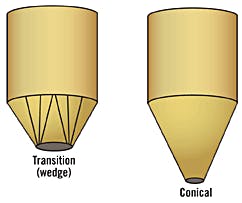
The hopper outlet must be large enough to prevent arching.
The flow sequence is one of first-in/ first-out. Therefore:
Solids that degrade with time can be stored.
Powders cannot flood if the material's residence time is sufficient for deaeration.
Particle segregation is minimized as the fines and coarse particles are reunited at the outlet.
Typically, steep cones and wedge-shaped hoppers (chisels, transition hoppers, etc.) are used to ensure mass flow.
Material flow properties
Solids flow property tests will identify, prior to equipment fabrication, just how a solid will flow in a particular geometry. You can confirm the validity of a proposed geometry by determining a material's cohesive properties and wall friction properties.
Flow property tests also can be used to identify a flow problem in an existing bin. These tests measure a material's cohesive strength, wall friction properties, compressibility and permeability.2
Cohesive strength measurements determine the opening size required to prevent arching and ratholing. Cohesive strength is the measure of a physical, chemical or electrical attraction holding a material together ," and potentially causing a flow obstruction to occur. When poured from a container, many bulk solids will flow like a liquid. Under these conditions, the material has no cohesive strength. However, when squeezed, a solid can gain enough strength through compaction to retain the shape of your hand.
Cohesive strength
is measured using a bench-scale laboratory testing device such as a direct shear tester. The material's cohesive strength is measured as a function of applied consolidation pressure. In a laboratory, a sample of the material is placed into a shear cell on the direct shear tester, and both compressive and shear loads are applied to simulate bin flow conditions.Once material in the shear cell is consolidated, you can measure its strength by shearing the material to failure. By repeating this procedure under different conditions, you can develop the resulting value of strength vs. consolidating pressure. The process is fairly straightforward; however, it requires time to simulate a range of pressures acting in a bin. Typically, three pressure levels are used to simulate the range of pressures that represent the pressures the material will experience in storage.
This test procedure simulates several other conditions that affect material flowability. The sample's moisture content and particle size can be controlled, and the direct shear tester simulates the effects of temperature and time of storage at rest on the sample.
Wall friction
values are expressed as a wall friction angle or coefficient of sliding friction. The lower the coefficient of sliding friction, the less steep the hopper walls need to be to ensure mass flow. You can measure the coefficient of sliding friction by determining the force it takes to slide a solid sample across a stationary wall surface. The friction that develops between the wall surface and the bulk solid resists this force.For a given bulk material and wall surface, the wall friction angle is not necessarily a constant, but often varies with normal pressure, usually decreasing as normal pressure increases. Once you have measured wall friction angles, you can determine hopper angles for mass flow. Jenike provided a means to determine the required angles for mass flow from the wall friction angle in his Bulletin 123.3
Compressibility
is a range of material bulk densities that vary as a function of consolidating pressure. A solid's bulk density is an essential value used in the analysis of its flow properties. Bulk solids do not just have loose and/or packed densities. They exhibit a range of bulk densities that depends on the consolidation pressure applied by the material in the bin. Compressibility values are useful for calculating hopper angles and opening sizes, as well as bin and feeder loads.Material permeability
is the material's ability to interact with air. You can determine a material's permeability by passing air or other gas through a representative column of bulk solid. The gas flow rate is measured while the pressure across the bed is regulated. This approach allows the bulk solid's permeability to be determined as a function of its bulk density.Permeability values can help you calculate critical, steady-state discharge rates through various size outlets in mass flow bins. You then can modify the bin geometry to increase discharge rate.
Flow and equipment performance
Flow problems can cause flow stoppages, equipment failure, downtime and degraded product quality. No-flow conditions such as arching or ratholing, erratic flow, flooding, limited discharge and segregation are typical flow problems. See Fig. 3 and Fig. 4. These problems can result in limited live capacity, caking or agglomeration, vibrations and structural failure. They also can increase feeder power requirements.
Figure 3. Arch Figure 4. Rathole
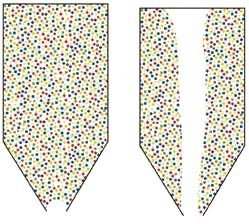
These two examples of no-flow conditions can result in limited live capacity, caking or agglomeration, vibrations and structural failure.
Bins and silos are intended to discharge product to a process, truck, railcar, package or other destination. When a poorly designed bin creates flow stoppages, it also affects efficiency. If a plant is dependent on a product it produces instead of purchases, the entire plant stops production when a flow problem occurs.
A gravity flow approach to ensuring flow from a bin is better than an approach requiring flow aid devices, which are noisy, require constant maintenance and do not always work well. Gravity-powered discharge is efficient, cost-effective and reliable.
Do not accept 70 degrees as a "magic angle" for mass flow. The hopper angle for mass flow depends on the smoothness and steepness of the hopper wall, as well as the properties of the bulk solid.
Feeders are intended to discharge material reliably and at a particular rate. If the feeder is not designed to withdraw material from the bin properly, it will cause one of the previously mentioned flow stoppages. Feeders meter solids at a controlled rate from a bin to a process, truck or other destination and must be designed to:
Maintain uniform flow across the entire outlet cross-sectional area to ensure mass flow.
Minimize solids loading to reduce feeder torque and motor requirements.
Control discharge rate accurately.
You can meet these requirements by learning about your bulk solids flow properties and proper feeder design techniques.
Often, it is necessary to transfer solids from the bin outlet to a process, truck or another bin. Equipment designed to mechanically convey or transfer solids works quite well. However, for short distances, this approach can be expensive.
Chutes can be used in place of expensive conveyors to transfer solids short distances. A chute is simply a pipe or trough that is sized properly and at the correct slope angle to ensure sliding of the material to be transferred. A chute must be steep enough and smooth enough to ensure sliding along its entire length.
Conclusion
To avoid flow problems, you must ensure the correct flow pattern, which ," in most cases ," is mass flow. To do so, you must measure your material flow properties and remember that the feeder design is as important as the bin design. You can go to great lengths to modify your bin for reliable flow and destroy your efforts by using an improperly designed feeder.
Marinelli is president of Solids Handling Technologies Inc. in Fort Mill, S.C. Since 1972, he has been active in testing bulk solids and consulting on materials handling systems design. He lectures frequently, teaching courses on solids flow principles and flow property testing, and has authored several papers and an encyclopedia section on the subject. He can be reached at [email protected] or (803) 802-5527.
References
1. American Society for Testing and Materials, Standard D 6128,"97.
2. Marinelli, J. A. and J. W. Carson. "Cha-racterize Bulk Solids to Ensure Smooth Flow," Chemical Engineering, April 1994.
3. Jenike, A. W. "Storage and Flow of Solids," Bulletin No. 123, University of Utah Engineering Experiment Station, Salt Lake City, November 1964.