Risk Assessment: Evaluating HAZWOPER Training Requirements
The other day I had yet another conversation with someone who was confused about the spill response training he needed for his operation. The first person he talked to said he needed 40 hours of training; the next person told him he needed 24 hours. Then he read about other training that requires eight hours or less. What does the U.S. Occupational Safety and Health Administration (OSHA) require and, more importantly, what is best for your operation?
An easy answer is: "Don't spill anything," but realistically, the potential for a spill or accidental release of chemicals always exists. Incident response might involve anything from a mop-and-bucket cleanup to an area evacuation with site controls, decontamination activities and fully encapsulating chemical-resistant suits with self-contained breathing apparatus. Training requirements could vary from just minutes to several days.
You must decide how you will handle a spill before it occurs. Time is a critical factor in any emergency ," decisions that could impact lives and the future of your plant need to be made quickly.
Many factors will dictate your level of response. Such factors include the properties of facility chemicals such as toxicity and vapor pressure, as well as the chemical quantities, types of processes and availability of local emergency resources. The potential impact on your employees, your operations and the community also are important factors.
Just because you handle chemicals or might need to respond to spills does not necessarily mean you must invest a lot in training and equipment. However, a significant investment may be warranted in some cases.
HAZWOPER
OSHA's Hazardous Waste Operations and Emergency Response Standard 29 Code of Federal Regulations (CFR) 1910.120, also know as the HAZWOPER standard, establishes safety and health requirements for "emergency response operations for release of, or substantial threats of releases of, hazardous substances without regard to the location of the hazard."
The bulk of the HAZWOPER standard, Sections b through p, covers hazardous waste operations such as clean-up procedures at hazardous waste sites and operations involving hazardous waste at treatment, storage and disposal facilities. The final section of the standard, Section q, covers emergency response.
When researching HAZWOPER issues or signing up for training, it is important that you address the appropriate issue. It is not uncommon for people to enroll in a HAZWOPER class to learn about spill response only to find out later ," during the actual training ," that the class focuses on hazardous waste sites.
Note: OSHA regulations, definitions, interpretations and resources for emergency response are available at www.osha.gov/SLTC/emergencyresponse.
Hazardous substances
When it comes to chemicals, a variety of definitions for "hazardous" exist. The U.S. Department of Transportation (DOT) is concerned with the hazards of materials in transport and orients its definitions of hazardous toward air transportation and other specific transport concerns. The U.S. Environmental Protection Agency (EPA) is concerned with the impact on the environment when materials are released or disposed and makes hazardous determinations based on environmental and human health risks.
OSHA is concerned with the hazards of materials to which workers might be exposed in the workplace. Any chemical that might present a health or physical hazard is defined as a hazardous chemical under the OSHA Hazard Communication Standard. Health hazards include any adverse health effect from irritants to corrosives or carcinogens.
The HAZWOPER standard applies to releases of hazardous substances. Although it is an OSHA standard, it does not use the Hazard Communication Standard for hazardous chemicals. The HAZWOPER standard traces its origin to an EPA law, the Comprehensive Environmental Response, Compensation and Liability Act (CERCLA, also known as Superfund), and derives its definition of hazardous substances from CERCLA regulations. The CERCLA definition is based on the substance's potential impact on the environment and the community.
In addition to hazardous substances listed under CERCLA, HAZWOPER also includes certain biological and disease-causing agents, DOT hazardous materials and hazardous waste in its definition. Biological and disease-causing agents include anthrax or other bioterrorism agents. Table 1 provides a summary of the classes of hazardous substances under HAZWOPER.
The definition might seem a bit confusing. The basic idea, however, is to include chemicals that would present a significant hazard to people or the environment if spilled or released. Chemicals that do not fall into one of these categories might still present a hazard to employees and emergency responders, but technically do not trigger HAZWOPER requirements.
Understanding emergency response
The emergency response will trigger many of the HAZWOPER requirements. The standard defines emergency response as:
", a response effort by employees from outside the immediate release area or by other designate responders (i.e., mutual aid groups, local fire departments, etc.) to an occurrence which results, or is likely to result, in an uncontrolled release of a hazardous substance. Responses to incidental releases of hazardous substances where the substance can be absorbed, neutralized, or otherwise controlled at the time of release by employees in the immediate release area, or by maintenance personnel are not considered to be emergency responses within the scope of this standard. Responses to releases of hazardous substances where there is no potential safety or health hazard (i.e., fire, explosion, or chemical exposure) are not considered to be emergency responses."
One of the first questions you need to ask is whether or not you will be performing emergency response. If your facility does perform emergency response, you must determine who is responsible for emergency response and to what level. The existence of a "spill team" does not necessarily mean the team performs emergency response.
For the protection of your employees, the facility and the community/environment, the capabilities and limitations of your spill team should be defined. No matter how sophisticated your spill response operations, it is essential to recognize your limitations.
A key factor in determining whether a release, or potential release, is an emergency is the degree of danger to employees. Examples of emergency situations include those that require evacuation, create conditions that might present an immediate danger to health and safety, pose a fire or explosion hazard or require immediate action because of the potential for additional damage. Nuisance spills and minor releases that do not require immediate attention are not considered emergencies.
You must consider several factors to determine whether or not an emergency exists. These include, but are not limited to, the quantity of the material; physical hazards posed by compressed gases, flammables, explosives, or oxidizers; and health hazards associated with poisons, corrosives or radioactive materials.
The nature of the operation and the operator's training and experience also should be considered. In a facility that routinely handles acids and that has trained and equipped its employees to safely handle incidental spills, many small acid spills might not be considered an emergency. In another facility with less training, equipment or experience, an identical spill might present an immediate hazard to employees. In this facility, therefore, spill response would be considered an emergency response.
Training requirements
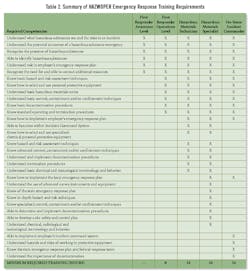
The HAZWOPER standard establishes five basic training requirements related to chemical emergency response: the First Responder Awareness Level, First Responder Operations Level, Hazardous Materials Technician, Hazardous Materials Specialist, and On-Scene Incident Commander training. These training levels are based on an emergency response. A summary of HAZWOPER emergency response requirements is provided in Table 2.
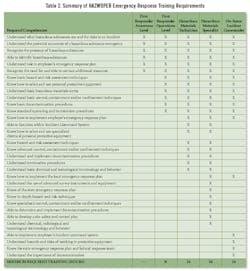
First Responder Awareness Level training is required for individuals who are likely to witness or discover a hazardous substance release and who would take no action beyond notification of the proper authorities. Even if you do not have a spill team and do not plan to respond to spill emergencies, your employees might need First Responder Awareness Level training. This training potentially could include everyone from the chemical operator to the security guard, mail clerk and salesperson. The standard specifies six areas of competency that must be achieved either through training or experience, including understanding the risks associated with a hazardous substance incident.
Elements of First Responder Awareness Level training are similar to Hazard Communication, DOT General Awareness, and Resource Conservation and Recovery Act (RCRA) Spill Prevention Control and Countermeasures (SPCC) training. Many elements of these training programs can be integrated to avoid duplicate training.
However, facilities must address the elements unique to each regulation. Important elements of First Responder Awareness Level training are the ability to determine the need for additional resources and the ability to make appropriate notification to the communication center.
First Responder Operations Level training is required for individuals who respond to releases or potential releases as part of the initial response. They are trained to respond in a defensive manner to protect people, property and the environment.
Defensive actions are those taken from a safe distance to keep the spill from spreading and to prevent exposures. Examples include covering drains, placing spill booms or barriers and barricading access points ," all from safe distances.
Eight hours of training or sufficient experience to demonstrate competency is required. The areas of required competency include hazard and risk assessment techniques, selection and use of personal protective equipment, spill control and containment, decontamination and standard operating procedures.
Hazardous Materials Technician training is required for individuals who will respond to the release or potential release for the purpose of stopping the release. They usually will be close to the source of the release and, therefore, have a high potential for harmful exposures. Examples include overpacking a leaking drum or collecting contaminated absorbents.
The investment in training, as well as in procedures and equipment, substantially increases when moving up to this level of response. The facility will need to train and equip enough people, including hazardous materials specialists and an incident commander, to meet a variety of requirements.
The Hazardous Materials Technician level calls for 24 hours of training. Personnel also must demonstrate competency in several areas, including the emergency response plan, instrumentation, the incident command system, selection and use of personal protective equipment, hazard and risk assessment, containment and control, decontamination, termination procedures and basic chemistry and toxicology.
Hazardous Materials Specialist training is similar to the Hazardous Materials Technician training. However, the specialist is required to have greater knowledge of the chemicals to which he or she might respond, as well as to act as a liaison with governmental authorities. He or she also provides support to the hazardous materials technician.
Twenty-four hours of training is required. Areas of required competency include those required of the hazardous materials technician, plus an understanding of the state emergency plan and in-depth hazard and risk assessment techniques. He or she also must be able to determine decontamination procedures, develop a site safety and control plan and demonstrate a greater knowledge of chemistry and toxicology.
On-Scene Incident Commander training is required for response beyond the First Responder Awareness Level. The role of the incident commander is to assume control of the incident scene. The incident commander must be someone on-site who is designated and trained to be in charge of the incident.
The required training will vary with the level and complexity of the response. The minimum required training is 24 hours, including at least First Responder Operations Level training. Competency must be demonstrated in implementation of the incident command system, the employer's emergency plan and the local emergency plan. He or she must understand the hazards and risks of working in personal protective equipment and the importance of decontamination.
The OSHA training requirements are a minimum. Based on the nature of your facility and its hazards, additional training could be necessary.
All levels of training require annual refresher training or a demonstration of competency. Drills and other activities can be used to demonstrate competency.
By allowing a HazMat team to respond to nonemergency spills, a facility provides an excellent way to maintain skills that would be needed in an emergency. Whatever you choose to do, you must remember to document the training and competency evaluations.
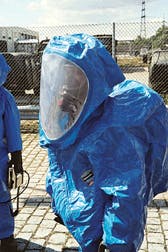
On-Scene Incident Commander Training includes details about the hazards and risks of working in personal protective equipment.
Assessing risks
Risk assessment is used to evaluate the severity and probability of potential incidents. Although many sophisticated risk assessment techniques are available, you do not need to have extensive training or education to apply the principles.
A simple method for risk assessment is to develop a list of potential scenarios and their probability (high, medium, low, improbable) and severity (high, medium, low, minor/none). This will enable you to quickly answer important questions.
A variety of resources are available for conducting more sophisticated risk assessments. They include EPA's Chemical Emergency Preparedness and Prevention Office, www.epa.gov/ceppo, and the National Safety Council's Crossroads Web site, www.crossroads.nsc.org.
What are your worst-case scenarios and how likely are they to occur? What incidents would have the greatest impact to your employees, the community and environment, or your business?
The risks and costs then can be compared to the costs and benefits of various levels of spill response. Maintaining a well-trained and equipped HazMat team is a considerable investment ," an investment that might be a bargain compared to the potential costs.
A variety of options exist between "everything" and "nothing." Evaluate the availability of outside resources. Are local spill response organizations available? What is their cost vs. the cost of maintaining an internal team? The outside spill team could perform the entire response, or support your internal capabilities.
An internal team could be trained to the First Responder Operations Level, taking only defensive measures to contain the spill. The outside service then could take offensive measures to control and collect the spill. This type of option allows rapid containment, cutting risk and losses, and reduces the amount of internal time and resources that must be used to maintain preparedness.
Satisfying your spill response needs is not about simple answers. It is about asking the right questions.
Burgess is a certified safety professional with Chatham, N.J. -based Emilcott Associates Inc., which specializes in industrial hygiene, health, safety and environmental consulting and training services. He can be reached at [email protected].